
How to Start a Weekly Family Night Everyone Looks Forward To
You announce family night with good intentions.
One child asks whether they have to come.
Another wants a completely different activity.
Someone is already tired.
By the time everyone agrees on what to do, the evening feels like more work than connection.
A weekly family night does not need an elaborate theme, an expensive outing, or several hours of perfectly cheerful togetherness.
The version families are more likely to keep is simpler:
When → Who Chooses → One Activity → Easy Ending.
Enough structure that everyone knows what is happening. Enough flexibility that real life does not destroy the tradition.
Start Smaller Than Your Ideal Family Night
The easiest mistake is making the first family night prove that family night is a great idea.
You plan special food.
Buy a new game.
Create three activities.
Maybe add decorations.
Now somebody has spent an hour preparing an evening everyone else is supposed to appreciate.
Start with a version you could repeat after an ordinary tiring week.
For example:
- 30 to 90 minutes, depending on your children’s ages.
- Usually at home.
- One main activity.
- An easy snack if you want one.
- A clear ending before everyone is exhausted.
With young children, twenty enjoyable minutes can count.
The goal is not to fill Friday night.
It is to create one familiar place in the week where the family intentionally spends time together.
1. When: Give Family Night a Regular Home
Choose a time with relatively low friction.
Friday night works for some families.
Sunday afternoon works better for others.
A quiet Wednesday evening might be your easiest window.
Then make that the usual time.
Predictability removes one recurring question:
“Are we doing family night this week?”
But predictable does not mean rigid.
If a school event lands on Friday, move family night.
If everyone is exhausted, shorten it.
If a preschooler is falling apart, finish early.
A useful tradition follows:
“We usually protect this time.”
not:
“This must happen exactly as planned or we failed.”
Have a Backup Window
If your schedule changes frequently, choose a default and a fallback.
For example:
Default: Friday after dinner.
Backup: Sunday afternoon.
That small decision prevents one busy evening from automatically canceling the whole week.
And some weeks, skipping entirely will still make sense.
A family tradition should support family life—not become another obligation everyone feels guilty about missing.
2. Who Chooses: Share Real Ownership
Family night is difficult to look forward to when the same parent selects every activity and everyone else is expected to be grateful.
Use a simple rotation.
Each week, one person chooses an activity that fits the family’s limits.
You might say:
“It’s your turn this week. We have about an hour, we’re staying home, and it needs to be something everyone can reasonably join.”
That is genuine choice inside a workable boundary.
Parents can still rule out activities that are too expensive, too late, unsafe, or unrealistic.
But avoid offering “choice” when only one answer will actually be accepted.
Do Not Require Unanimous Enthusiasm
Your 8-year-old chooses a card game.
Your 13-year-old would rather watch a movie.
You do not need to spend twenty minutes finding the one activity every family member rates 10 out of 10.
The rotation solves that problem.
Try:
“You don’t have to love tonight’s choice. It’s your sister’s turn this week. Give it a fair try, and you’ll get a turn too.”
Family night can require reasonable participation without requiring everyone to perform excitement.
This matters especially with older children, who are likely to resist a tradition that always means doing whatever younger siblings enjoy.
Give teens meaningful turns too.
If Choosing Becomes the Hardest Part, Shrink the Menu
Sometimes family night starts with:
“What should we do?”
followed by twenty minutes of:
“I don’t know.”
“Not that.”
“That’s boring.”
Create a small list of reliable options instead.
Maybe:
- Board or card game.
- Movie.
- Simple baking or cooking.
- Walk plus dessert.
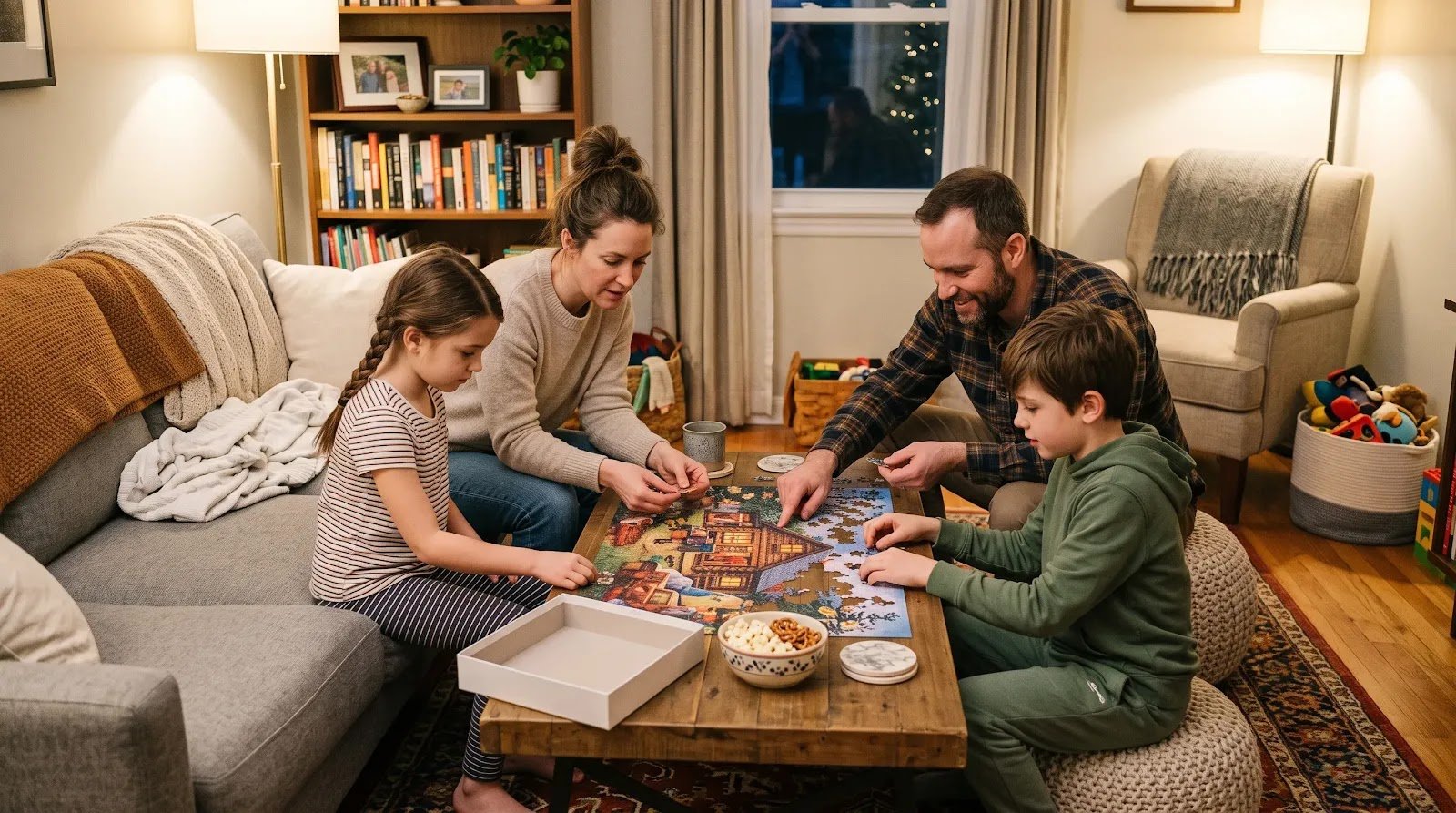
- Puzzle or building challenge.
- Drawing or craft.
- Indoor picnic.
You do not need a brand-new Pinterest-worthy idea every week.
If you want a quick option without another family debate, the Free Screen-Free Activity Picker for Families can choose from simple activities for you.
3. One Activity: Resist Overplanning
Family night does not need:
Game.
Then craft.
Then dessert-making.
Then conversation questions.
Then movie.
Pick one main thing.
If people naturally keep hanging out afterward, great.
If not, the evening still counted.
Overplanning creates more setup, more transitions, more opportunities for disagreement, and more work for whoever is organizing it.
Simple is easier to repeat.
Keep Preparation Shared—or Keep It Tiny
A weekly tradition becomes fragile when one parent spends an hour cleaning, shopping, cooking, and setting everything up before everybody else appears.
Either share small preparation jobs or choose an activity that barely needs preparation.
For example:
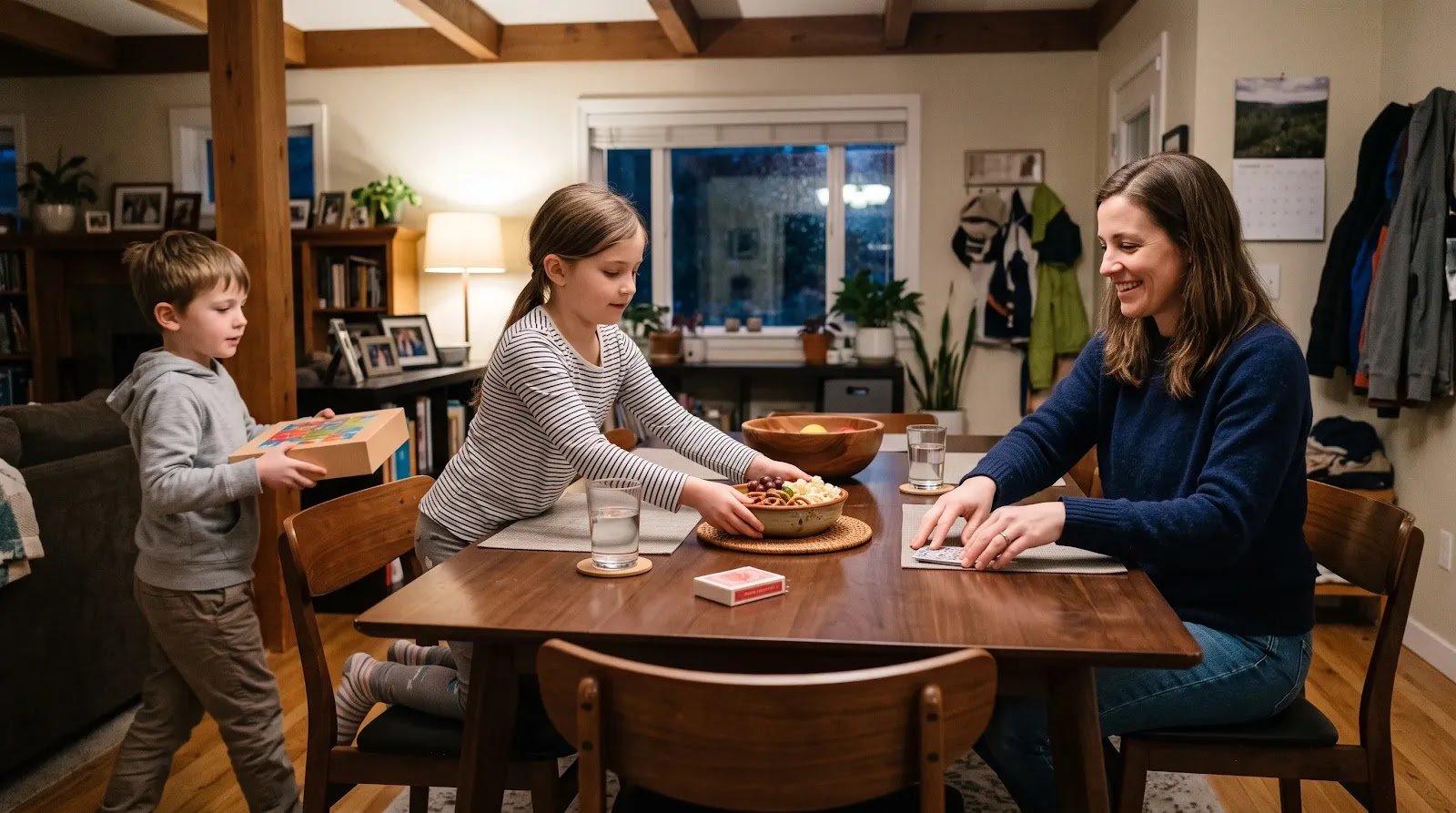
One person gets the game.
Another brings cups.
Someone chooses music while you make popcorn.
That is enough.
Do not turn setup into another chore-management system.
Protect Family Night From Household Business
You finally have everyone together.
Suddenly you remember:
The messy bathroom.
The missing homework.
The dishwasher nobody emptied.
Saturday’s schedule.
Unless something genuinely needs attention now, save it.
Family night should not quietly become a household meeting with snacks.
If you need to discuss rules, responsibilities, schedules, or a family problem, how to have a family meeting that kids actually participate in covers that different purpose.
Shared Screens and Separate Screens Are Different
A family movie can absolutely be family night.
The issue is not whether a screen exists.
The useful distinction is:
Are we doing something together, or are five people sitting near each other while doing five separate things?
If you choose a movie, watch together.
If you choose a game, personal scrolling can wait.
If you are eating dessert and talking, consider putting non-urgent notifications aside for that short period.
Parents need to follow the same expectation.
Kids notice quickly when adults keep checking phones while telling everyone else to participate.
Leave Room for Conversation Without Scheduling a Deep Talk
One reason simple shared activities work well is that conversation can happen beside them.
Someone starts talking while you walk.
A child tells a story while making pizza.
A teenager mentions something during a puzzle because nobody is staring directly at them waiting for a meaningful answer.
You can invite conversation without requiring it.
If everyone is quiet and you want an easy prompt, use one question from the Free Conversation Starter Generator for Families & Couples.
Then let the conversation go where it goes.
If nobody wants to discuss anything profound, that is fine too.
Connection can also look like laughing at the same ridiculous game.
4. Easy Ending: Stop Before Family Night Becomes a Test of Endurance
A good activity is going well.
So you keep extending it.
Then the preschooler melts down.
A sibling starts arguing.
The teen disappears mentally.
Now the last twenty minutes are what everybody remembers.
Give family night a natural endpoint.
“One game.”
“One movie.”
“Until 8:00.”
“Dessert, then we’re done.”
Ending while the evening still feels reasonably good is often better than squeezing every possible minute out of it.
Match the Night to the Ages You Actually Have
With younger children: Keep it early, concrete, and short. Twenty or thirty minutes can be plenty. Do not sacrifice bedtime just to create a more impressive family event.
With school-age kids: Give them meaningful turns choosing and helping with simple setup. One activity usually works better than a packed schedule.
With preteens and teens: Ask what would make family night worth protecting from their perspective. Cooking, dessert out, a movie, a quick game, a walk, or simply eating together may work better than your original idea of “family bonding.”
Older children also have legitimate homework, sports, work, and social commitments.
Respecting those does not weaken the tradition.
It helps keep the tradition realistic.
Use the Minimum-Viable Version on Exhausting Weeks
Everyone is tired.
Nobody wants setup.
Your normal hour-long family night sounds impossible.
Use the tiny version:
- 20 minutes.
- One easy snack.
- One activity that is already available.
- No pressure to extend it.
Maybe you play one round of cards.
Maybe you make hot chocolate and watch one short show together.
Maybe you walk around the block.
The point is not protecting a streak at all costs.
It is allowing the tradition to survive weeks with less energy.
If Family Night Keeps Failing, Fix One Friction Point
Do not immediately decide:
“Our family just doesn’t like family night.”
Ask what specifically is failing.
Nobody chooses?
Keep a five-option list.
Everyone argues over the activity?
Use a rotation.
The kids lose interest?
Make it shorter.
One parent does all the work?
Reduce preparation.
The regular night keeps getting interrupted?
Use a backup window.
Older kids resist?
Check whether they have meaningful choices or whether “family night” always means entertainment designed for younger children.
Keep the tradition if the tradition still serves you.
Change the part creating unnecessary friction.
Let Repetition Create the Tradition
You do not need to manufacture a magical family tradition on week one.
Start with:
When?
Choose the regular window.
Who chooses?
Rotate meaningful ownership.
What are we doing?
One manageable shared activity.
When are we done?
Use an easy endpoint.
Then repeat.
After a while, the details that nobody planned may become the memorable part:
The snack everyone expects.
The inside joke.
The playlist.
The child who always explains the rules incorrectly.
The argument over who gets the favorite seat.
That is how many family traditions actually develop.
Not because somebody engineered a perfect evening.
Because a simple evening was enjoyable enough to happen again.