
How to Help an Older Child Adjust to a New Baby
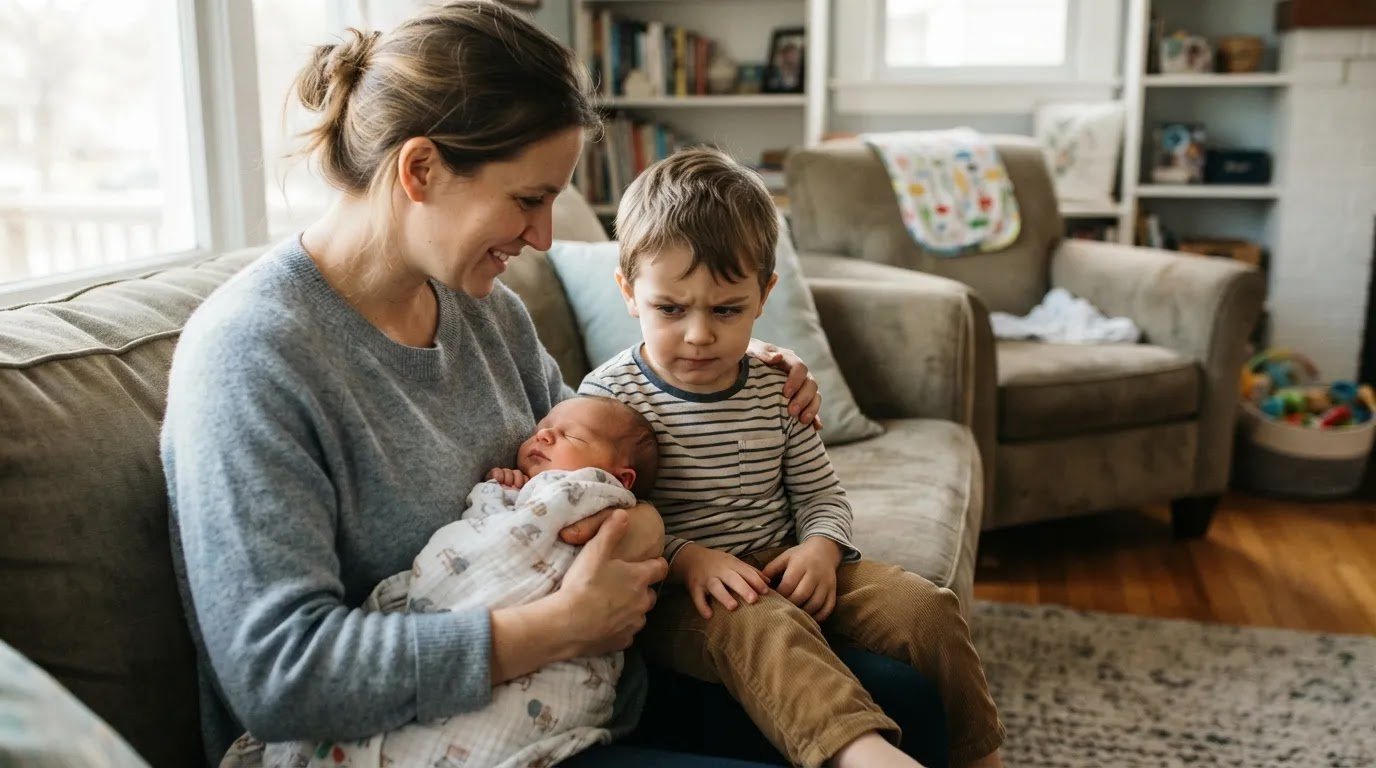
Your child stopped asking to be carried months ago.
Then the baby comes home.
Suddenly, while your arms are full of newborn, your older child looks up and says:
“Carry me.”
You may wonder whether they are jealous, regressing, seeking attention, or simply having a hard day.
It could be some combination of those things.
But something else is also true: their family changed, your availability changed, and they may be checking whether their place with you changed too.
Helping an older child adjust to a new baby is not about making them adore their sibling immediately.
A more useful goal is helping them learn:
Some things are changing. Some important things are still mine. And I still belong here.
Use Keep, Change, and Choose
A new baby changes dozens of small parts of family life at once.
Make the transition easier by sorting those changes into three buckets:
Keep: What familiar part of your older child’s life can remain reliably theirs?
Change: What will genuinely be different?
Choose: Where can your child decide how involved they want to be?
This gives you a better plan than repeating:
“You’re going to be such a great big brother!”
They may be excited.
They may also be bored, clingy, proud, irritated, curious, protective, disappointed—or several of those in the same afternoon.
Keep: Protect One Familiar Piece of Their Life
You cannot preserve the entire pre-baby routine.
Bedtime may shift.
A parent may temporarily stop doing school drop-off.
Dinner may happen later.
Visitors may suddenly focus on someone else.
Instead of promising nothing will change, protect one or two small things your child can still count on.
Maybe:
- One bedtime book.
- Saturday pancakes.
- A few minutes together after school.
- A familiar goodnight ritual.
- A regular activity that remains theirs when possible.
The American Academy of Pediatrics recommends continuing to make time for an older child’s needs and activities and setting aside individual time after a new baby arrives. Its guidance on preparing older children for a new baby also notes that preschoolers can find changes in family routines especially difficult.
The protected ritual does not need to be impressive.
Ten predictable minutes can matter more than repeatedly promising a huge “special day” that newborn life may make impossible.
Change: Tell the Truth About What a Newborn Is Like
Adults understandably sell the exciting version:
“You’ll have somebody to play with!”
Then the baby arrives and mostly sleeps, eats, cries, needs diaper changes, and occupies adult arms.
That can feel like false advertising.
Before the birth, give your child a realistic picture:
“At first the baby will be very little. They’ll sleep and eat a lot and cry when they need something. It will take time before they can really play with you.”
AAP guidance specifically recommends being honest with preschoolers that a newborn will cry, need substantial adult time, and will not become a playmate immediately.
Honest expectations narrow the gap between:
“I’m getting a new best friend!”
and:
“Why does this person only cry and take Mom?”
Avoid Stacking Too Many Big Changes
If you have flexibility, avoid making the baby’s arrival the deadline for every other childhood transition.
Imagine being told:
The baby gets my crib.
I move bedrooms.
I start preschool.
I stop using my pacifier.
Mom goes to the hospital.
Then she returns with someone new.
Some changes cannot be avoided.
But AAP guidance recommends, when possible, completing major transitions such as toilet training or moving from a crib to a bed before the baby arrives—or waiting until the household has settled afterward.
The goal is not preventing all change.
It is avoiding several difficult adjustments landing on the same child at once.
Choose: Invite Participation Without Assigning a New Job
Many children enjoy helping with a baby.
Invite that interest without making it compulsory.
A younger child might:
- Choose between two baby outfits.
- Bring a clean diaper.
- Sing to the baby.
- Sit beside you during a feeding.
An older child might:
- Choose a book to read nearby.
- Help select baby clothes.
- Bring something during a diaper change.
- Interact gently with the baby under adult supervision.
AAP guidance encourages age-appropriate involvement and teaching children how to interact safely with a newborn.
But there is an important difference between:
“Want to help me choose the baby’s pajamas?”
and:
“You’re the big sister now, so you need to help.”
Let “no thanks” sometimes be an acceptable answer.
A sibling relationship does not have to be manufactured during the first week.
Do Not Require Excitement
Your child says:
“I don’t like the baby.”
You may want to immediately reply:
“Don’t say that. You love your brother.”
But adjustment is easier when the real feeling is allowed into the room.
Try:
“You’re really not enjoying having the baby around right now.”
Then listen.
Maybe:
“The crying wakes me up.”
“Everyone only talks about the baby.”
“You never play with me anymore.”
“I thought she would be fun.”
You do not have to agree with every statement to hear the feeling underneath it.
And accepting the feeling does not mean accepting unsafe behavior:
“You can be angry about the baby. You may not hurt the baby.”
If hard feelings make you want to immediately reassure, correct, or solve them, how to listen to your child without immediately fixing every problem can help with that part of the conversation.
Expect Some Younger-Seeming Behavior
A preschooler who had been independent may suddenly want more help.
You might notice:
- More clinginess.
- Wanting to be carried.
- Asking for help with familiar tasks.
- Baby-like speech.
- Sleep disruption.
- Occasional toileting accidents after previously reliable toilet use.
AAP guidance notes that some preschoolers temporarily regress after a new sibling arrives.
Avoid humiliation:
“Stop acting like a baby.”
Instead, offer some comfort without automatically removing every age-appropriate expectation.
For example:
“You want help with your shoes today. I’ll help with the first one, and you do the second.”
Or:
“You want a cuddle too. Come sit with me.”
Being “the big kid” should not mean losing access to comfort.
Let the Baby Wait Occasionally Too
Your older child hears:
“Wait. I’m feeding the baby.”
“Not now. The baby needs me.”
“Be quiet. The baby is sleeping.”
Some of that is unavoidable.
But when the baby is safe and the need is not urgent, your older child can occasionally hear:
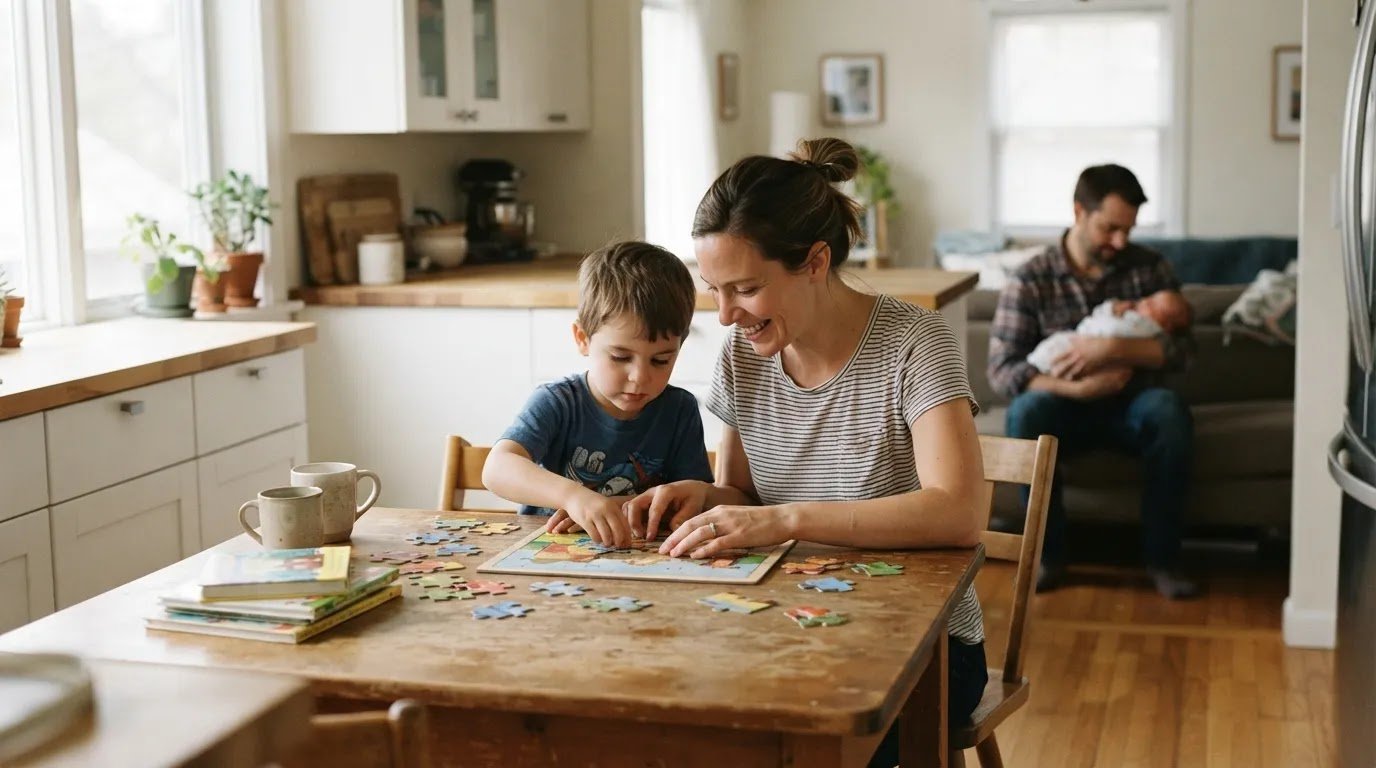
“Baby, you’ll need to wait one minute. I’m helping your brother finish his puzzle.”
The newborn does not understand the sentence.
Your older child does.
The message is:
You still get turns with me.
Protect Five Minutes Instead of Promising an Hour
Newborn days are unpredictable.
Large promises can repeatedly collapse.
Instead, use small pieces of connection you can realistically protect:
- Five minutes drawing.
- A short bedtime conversation.
- A snack together.
- A walk to the mailbox.
- One chapter of a book.
- A quick game while another adult has the baby.
One-on-one time does not need to be long to say:
“I still notice you when the baby is not part of the activity.”
Notice What Visitors Communicate Too
The door opens.
“Where’s the baby?”
“Look how tiny!”
Gifts appear.
Phones come out.
The older child becomes almost invisible.
You cannot control every visitor, but you can ask close relatives and friends to greet and include the older child too.
AAP guidance specifically recommends that family and friends spend time with the older sibling after the baby arrives so the child is less likely to feel overlooked.
Grandparents and trusted relatives can be especially helpful—not only by holding the baby, but by giving the older child some ordinary attention away from newborn-centered life.
Protect the Parts of Their Identity That Have Nothing to Do With the Baby
Not every conversation needs to begin with:
“How do you like being a big brother?”
Your child is still interested in dinosaurs.
Still has soccer.
Still has friendship problems.
Still wants to show you a drawing.
Still needs help finding the library book.
Keep asking about those things.
The baby joined your child’s life.
The baby does not need to become your child’s entire identity.
Adjust the Support to Age
Toddlers: Keep explanations concrete. They may understand little about what “a baby is coming” means. Prioritize affection, familiar routines, and close supervision around the newborn.
Preschoolers: Expect mixed feelings, sensitivity to changes in attention, and possibly some temporary regression. Invite simple participation while letting them still need closeness themselves.
School-age children: Explain how the first weeks may affect schedules, visitors, noise, and adult availability. Keep supporting school, hobbies, friendships, and time with you.
Tweens and teens: They may be delighted—or surprisingly uninterested. Do not assume age automatically makes them a babysitter or substitute caregiver. Ask what level of involvement feels reasonable.
Keep Newborn Interaction Safe and Adult-Led
An older sibling can be loving and still be too young to make newborn-safety decisions independently.
Teach concrete rules:
“Ask an adult before picking up the baby.”
“Touch the baby gently.”
“If you’re sick, we’ll give the baby more space.”
HealthyChildren.org’s guidance on protecting newborns from germs recommends good hand hygiene and limiting close contact from family members who may be sick because newborns are particularly vulnerable to infection.
If your older child becomes rough or aggressive around the baby, stop the behavior immediately and supervise closely.
You can still acknowledge the feeling:
“You’re angry that I picked up the baby. I won’t let you hit her.”
Do Not Measure Adjustment by Instant Sibling Love
Some children want to hold the baby constantly.
Some look for thirty seconds and return to their toys.
Some are fascinated for a week and then lose interest.
Some need much longer.
You do not need to manufacture closeness for a photograph.
Look instead for gradual adjustment:
- Your child tolerates the new routine a little better.
- They ask directly for your attention more often.
- They can be near the baby safely.
- They return to their own interests and routines.
- Curiosity or affection appears on their own terms.
The sibling relationship has years to develop.
When the Adjustment Needs a Closer Look
There is no single correct reaction to a new sibling.
Some children adapt quickly.
Others need longer.
Occasional clinginess, jealousy, frustration, or younger-seeming behavior can happen during the transition.
Look at the larger pattern rather than trying to diagnose one behavior.
Talk with your child’s pediatrician or another appropriate qualified professional if distress is intense or persistent, significantly disrupts sleep, school, eating, relationships, or everyday functioning, or if you are concerned about repeated aggression toward the baby or another major behavioral change.
The most useful question is usually not:
“Is my child jealous?”
It is:
“How is this transition affecting this child, and what support do they seem to need?”
Your Older Child Does Not Need to Become “The Big Kid” Overnight
A new baby creates a new sibling.
It does not erase the child who was already there.
Your older child can be proud and jealous.
Helpful and needy.
Curious today and uninterested tomorrow.
They can love the baby and still wish, briefly, that life felt the way it used to.
Adjustment does not require eliminating those contradictions.
Keep something familiar.
Explain what is changing honestly.
Let participation include some choice.
And keep showing your older child that the family grew without their place in it becoming smaller.