
Free Printable Morning Routine Chart for Kids
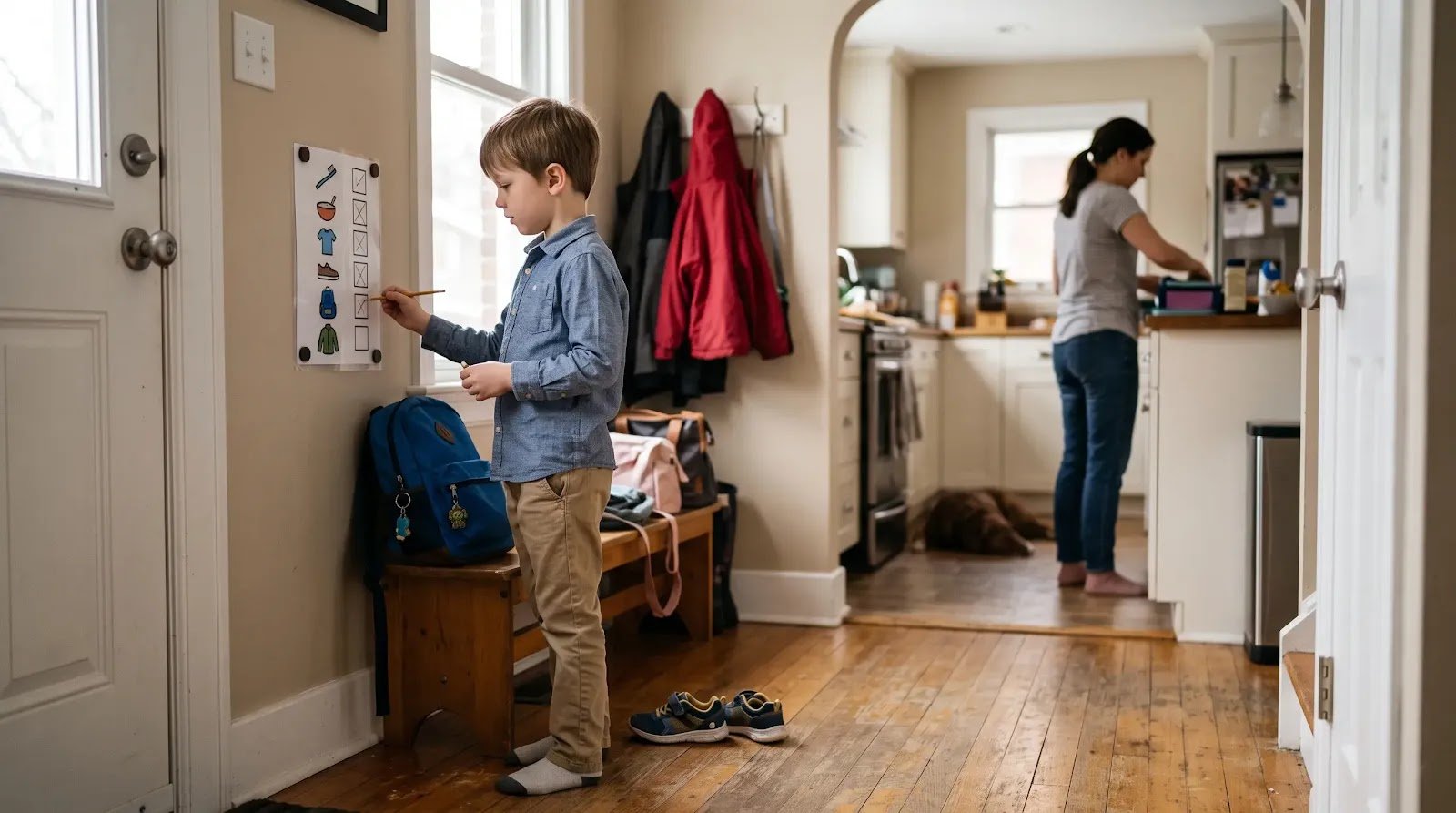
If your morning sounds like “Get dressed,” “Did you brush your teeth?” and “Where is your backpack?” on repeat, this printable is meant to move some of that remembering out of your voice and onto one simple chart.
Use the ready-made version below as-is, or customize the blank chart so it matches the steps your child actually needs before leaving the house.
Free Printable Morning Routine Chart
This version works well as a starting point for many preschool and elementary-age children. Remove any step your family does not need and change the order when necessary.
| Step | Morning Task | Done |
|---|---|---|
| 1 | Wake up and use the bathroom | □ |
| 2 | Get dressed | □ |
| 3 | Eat breakfast | □ |
| 4 | Brush teeth and hair | □ |
| 5 | Pack lunch or water bottle if needed | □ |
| 6 | Check backpack and school items | □ |
| 7 | Put on shoes and outerwear | □ |
| 8 | Go to the family’s ready-to-leave spot | □ |
How to use it: Print the chart, cross out any steps your child does not need, and keep it somewhere the routine actually happens—not tucked inside a drawer.
A younger child may do better with only four or five steps. An older child may be ready to manage the entire sequence with much less adult prompting.
Blank Morning Routine Chart to Customize
If your mornings do not match the sample—and many will not—use this blank version.
| Step | My Morning Routine | Done |
|---|---|---|
| 1 | ____________________________ | □ |
| 2 | ____________________________ | □ |
| 3 | ____________________________ | □ |
| 4 | ____________________________ | □ |
| 5 | ____________________________ | □ |
| 6 | ____________________________ | □ |
| 7 | ____________________________ | □ |
| 8 | ____________________________ | □ |
Build the Chart Around Your Real Morning
The goal is not to create the most complete checklist possible.
It is to create the shortest sequence that reliably gets your child from waking up to ready to leave.
The CDC’s current guidance on family routines emphasizes consistency and predictability: children benefit from knowing what happens next, while routines should still fit the child’s capabilities and the family’s actual life.
Start with the steps your child regularly needs reminders for.
If “eat breakfast” already happens without a problem, you may not need it on the chart.
If “find glasses” causes a search every morning, that may deserve its own step.
Keep the Chart Small: A printable is supposed to reduce mental load. If your child has to study twelve boxes before getting dressed, simplify it. Combine familiar steps and keep separate only the parts that genuinely need reminders.
Use Action Words Your Child Understands
A chart works better when each row describes something your child can actually do.
Instead of:
“Get ready.”
write:
“Get dressed.”
Instead of:
“Take care of school stuff.”
write:
“Put folder and water bottle in backpack.”
If your child is not reading independently yet, add simple hand-drawn symbols, stickers, or family photos beside the steps.
The chart does not need to look professionally designed to work in your home.
Put the Chart Where the Next Step Happens
Placement matters.
A beautifully printed chart on a bedroom wall may not help if most of the routine happens downstairs.
Possible locations include:
- Near the child’s bedroom door.
- On the refrigerator.
- Beside the bathroom mirror.
- Near the family’s backpack and shoe area.
- Inside a clear sleeve on a kitchen cabinet.
The best location is where your child can look at it without needing you to retrieve it.
Teach the Chart Before Expecting Independence
Do not hang it up Sunday night and expect Monday morning to run itself.
Walk through the sequence with your child when nobody is rushing.
You might say:
“Tomorrow morning, instead of me reminding you about every step, we’re going to use this list. When you finish one thing, check what comes next.”
For the first few mornings, you may still need to redirect:
“Check your chart. What’s next?”
That is different from supplying the answer every time.
The aim is for the chart to gradually carry more of the remembering.
If the Chart Keeps Stalling at the Same Step, Fix the Routine
A printable cannot solve every morning problem.
Suppose the child reaches:
“Check backpack.”
And every day the homework, library book, and shoes are scattered through the house.
The chart is not failing.
It has revealed where the routine needs work.
You might move backpack preparation to the evening or create one place where school items wait overnight.
HealthyChildren.org recommends preparing clothes, backpacks, and lunches ahead of time when possible to streamline school mornings.
For the full setup—not just the printable—use our guide to building a morning routine that gets kids out the door on time.
Customize It by Age
Preschoolers
Use fewer steps and make them concrete.
A simple chart might be:
- Bathroom.
- Get dressed.
- Breakfast.
- Brush teeth.
- Shoes and backpack.
Expect adult help. The chart provides predictability; it does not make a young child suddenly independent.
Early Elementary Kids
This is often a useful age for a more complete visual sequence.
Include the steps your child can genuinely perform and let the chart become the first reminder.
You can still help with anything that exceeds their current skill level.
Older Elementary Kids
Begin combining familiar tasks.
Instead of separate rows for every tiny action, an older child might have:
- Get dressed and ready.
- Breakfast.
- Bathroom and teeth.
- Check school bag.
- Shoes and leave.
The chart should become simpler as the routine becomes more automatic.
Try a Reusable Version
If your child enjoys physically checking things off, place the printed chart in a reusable clear sleeve or laminate it and use an appropriate erasable marker.
Reset it each evening.
For some children, however, checking every box becomes unnecessary after the routine is familiar.
That is a success.
The goal is not to create lifelong dependence on a morning chart.
The goal is to provide enough structure while the sequence is still being learned.
When You Need More Than a Printable
This chart is useful when the problem is:
“My child knows how to do these tasks but keeps losing track of what comes next.”
It does not by itself solve:
- A bedtime that leaves the child chronically exhausted in the morning.
- A schedule that does not allow enough time to get ready.
- Repeated battles over expectations that have not been clearly agreed on.
- A task your child does not yet know how to perform.
- Persistent school-morning distress that may need a closer look.
If the sequence needs more customization than a static chart can provide, the Free Family Routine Builder lets you build a routine around your family’s own steps.
A Simple Way to Start Tomorrow
Do not redesign the entire morning tonight.
Choose the version above that is closest to your routine.
Remove anything unnecessary.
Add the one or two steps your child genuinely forgets.
Put the chart where they can see it.
Then tomorrow, instead of immediately saying:
“Go brush your teeth.”
try:
“Check your chart. What’s next?”
If the chart eventually means you have to answer that question less often, it is doing exactly what it was made to do.