
How to Teach Kids to Take Responsibility for Mistakes

The cup tips.
Milk runs across the table and onto the floor.
Your child freezes.
Then comes the defense:
“It wasn’t my fault! My elbow slipped!”
You know their elbow knocked it over.
But this moment does not really need a courtroom.
A more useful question is:
“Okay. What needs to happen now?”
That gets closer to what responsibility actually means. It is not forcing a confession, making a child feel guilty, or getting the perfect apology. It is learning to face what happened, recognize your part, repair what you reasonably can, and make a better plan for next time.
Teach Responsibility as Four Questions
When something goes wrong, guide your child through:
- What happened?
- What part was yours?
- What needs repair now?
- What will you try differently next time?
Not every mistake needs a long discussion. Sometimes the whole process is:
“The water spilled.”
“My cup was too close to the edge.”
“I’ll wipe it up.”
“Next time I’ll move it farther in.”
That is responsibility in action.
Focus on the Mistake, Not the Child’s Identity
Compare:
“You forgot to put the library book in your backpack.”
with:
“You’re so irresponsible.”
The first names a problem that can be fixed.
The second turns the problem into an identity.
HealthyChildren.org recommends focusing communication on the child’s behavior rather than attacking or labeling the child personally.
Try:
“The homework didn’t make it into your backpack. What can we do about it now?”
A child cannot repair “I am irresponsible.”
They can repair “I forgot the homework.”
An Accident Can Still Need Repair
“But I didn’t mean to!”
Your child may be completely right.
Intent matters. Accidentally spilling a drink is different from deliberately pouring it onto the floor. Accidentally bumping a sibling is different from hitting them on purpose.
But an accident can still leave something that needs attention.
You can say:
“I know you didn’t mean to spill it. You still need to help clean it up.”
Or:
“I believe you didn’t mean to tear her picture. Let’s see what we can repair.”
This teaches an important distinction:
You do not need bad intentions to take responsibility for what happened next.
Start With “What Happened?” Instead of “Why Did You Do That?”
“Why?” can sometimes be useful.
But immediately after a mistake, a child may honestly not know why they did something—or the question may sound so accusatory that all their energy goes into defending themselves.
Start with something concrete:
“Tell me what happened.”
Then:
“What part of that was your choice?”
If understanding the trigger would help, ask later:
“What was happening right before that?”
You are looking for useful information, not a perfect psychological explanation produced on demand.
Do Not Create a Confession Trap
If you watched the ball hit the lamp, do not begin with:
“Do you know who broke the lamp?”
You already know.
That question creates an unnecessary second test about honesty.
Try:
“The ball hit the lamp and broke it. Let’s figure out what happens next.”
If your child lies about what happened, dishonesty can be addressed too. But you do not need to manufacture an opportunity to lie before dealing with the original mistake.
Separate Context From Ownership
A child may say:
“But she started it.”
“He made me angry.”
“The teacher didn’t remind me.”
There may be truth in those statements.
Responsibility does not require pretending context does not exist.
Try:
“Maybe your brother did tease you. We’re talking about the part you chose—throwing his controller.”
Or:
“It would have helped if I reminded you. The assignment was still yours to bring.”
The useful question is:
“What was your part?”
not:
“Who deserves 100% of the blame?”
If your child is defensive and you are not sure you have the whole story, listen to the full story without immediately trying to fix it—then return to the part your child can actually own.
Match the Repair to the Mistake
“Take responsibility” is abstract. Repair is concrete.
If you made a mess: help clean it.
If you damaged something: help repair or replace it in an age-appropriate way.
If you hurt someone: check on them, acknowledge what happened, apologize when appropriate, and repair what can be repaired.
If you forgot a responsibility: do what can still be done and create a better reminder for next time.
If you broke a clear rule: accept the reasonable consequence and focus on what behavior is expected next time.
The CDC’s current behavior guidance recommends clear, consistent consequences and briefly explaining why they follow from the behavior.
If you need to explain that consequence without turning it into a speech, see how to explain consequences without lecturing.
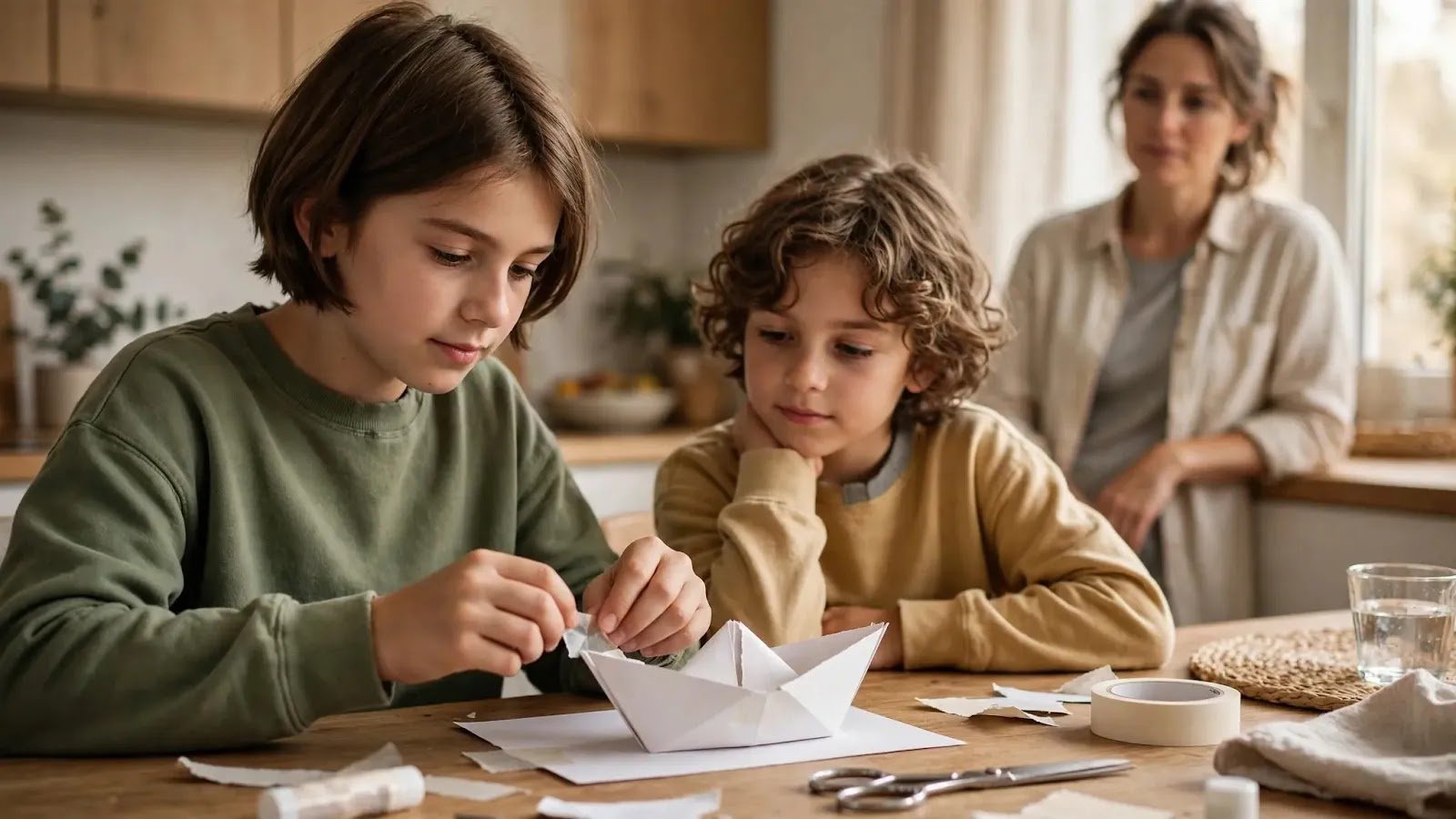
An Apology Is Part of Repair—not the Entire Repair
Your child pushes a sibling.
You say:
“Say sorry.”
“Sorry.”
Then the child grabs the toy again.
The required word appeared. The situation did not improve much.
Instead of stopping at the apology, help the child notice what needs repair:
“You pushed him and he fell. What needs to happen now?”
Depending on age and situation, that might include:
- Checking whether the other child is okay.
- A sincere apology.
- Returning something that was taken.
- Helping rebuild or repair something.
- Giving the other person space.
- Changing how play continues.
Do not force physical affection as proof of remorse. The child who was hurt may not want a hug.
The goal is meaningful repair—not an apology performance.
Do Not Rescue So Fast That You Remove the Repair
Your child spills cereal. You automatically clean it.
They forget sports equipment. You immediately drive home for it.
They leave a project until the last minute. You stay up finishing half of it.
Helping children is part of parenting.
But before taking over, ask:
“What part of this can my child reasonably handle?”
A young child can bring a towel for a safe spill.
A school-age child can help explain a forgotten assignment with appropriate adult support.
An older child may be able to tell a coach they forgot something instead of having a parent invent an excuse.
Support the repair without quietly becoming the person responsible for all of it.
Use Consequences to Support Responsibility—not Shame
Sometimes repair is enough. Sometimes a reasonable consequence also belongs in the situation.
If a child repeatedly misuses an item, access to that item may change.
If they deliberately create a mess, helping clean it may be part of what follows.
What usually adds less value is an unrelated punishment designed mainly to make the child feel worse.
AAP guidance recommends discipline that teaches behavior and discourages shaming, humiliation, and harsh verbal responses. HealthyChildren.org’s positive-discipline guidance also emphasizes clear limits and consequences rather than attacks on the child.
The goal is:
“Can you face what happened and respond constructively?”
not:
“Can I make you feel bad enough to prove you understand?”
If Your Child Collapses Into “I’m Terrible,” Keep Accountability Specific
Some children move very quickly from:
“I made a mistake.”
to:
“I’m the worst.”
“I ruin everything.”
You can reject the identity statement without making the original problem disappear:
“You are not terrible. You made a hurtful choice. We’re going to repair what we can.”
Or:
“Making a mistake doesn’t make you bad. You still need to take responsibility for this part.”
This keeps both things true: the child is more than the mistake, and the mistake still needs attention.
Make the Next-Time Plan Concrete
“I’ll never do it again” sounds reassuring.
It is not much of a plan.
Ask:
“What will you do differently next time?”
If the answer is:
“I’ll remember.”
ask:
“How?”
Forgotten homework might become:
“When I finish it, it goes straight into the backpack.”
A sibling argument might become:
“If I’m getting too angry, I’ll put the controller down before I answer.”
A spill might become:
“I’ll keep my cup farther from the edge.”
A useful responsibility lesson changes the next attempt.
Let Your Child See You Own Mistakes Too
Children notice what adults do after getting something wrong.
Suppose you snap at your child when you are stressed.
Later:
“I was frustrated, but I shouldn’t have yelled at you. I’m sorry. Next time I’m going to take a minute before I answer.”
Notice the pattern:
Own → Repair → Next plan.
AAP guidance specifically recommends that parents who make a mistake cool down, apologize, explain what they will do differently, and then follow through.

Leave “But” Out of the Apology
“I’m sorry I yelled, but you wouldn’t listen.”
The second half quietly transfers responsibility back to the other person.
Try:
“I’m sorry I yelled. That was my mistake.”
If another issue also needs discussing, do it separately:
“We also need to talk about what was happening before I became frustrated.”
Two people can both have something to take responsibility for.
Adjust Responsibility to the Child’s Age
Preschoolers: Keep repair immediate and concrete.
“The blocks spilled. Help me put them back.”
Elementary-age kids: Let them identify more of the solution.
“You forgot your library book again. What might help you remember it on library day?”
Tweens and teens: Shift more ownership toward them.
“You missed the deadline. What do you think your next step with the teacher should be?”
You remain available for guidance and safety. You do not need to become the spokesperson for every mistake.
When Your Child Tells You Before You Find Out
Your child comes to you and says:
“I broke the headphones.”
Your first reaction matters.
You do not need to celebrate the broken headphones.
Try:
“I’m glad you told me. Let’s look at what happened and figure out what needs to happen next.”
Repair or a reasonable consequence can still follow.
But telling the truth should not make the outcome dramatically worse than hiding the mistake until someone discovers it.
You want your child to learn:
“Owning the mistake gets me into the repair process.”
Let an Ordinary Mistake End
Your child admitted it.
They cleaned it up.
They apologized where appropriate.
They accepted the consequence.
They made a plan.
Three days later, they should not still be hearing:
“Remember what you did?”
Ordinary mistakes need an exit.
Serious or repeated behavior may require trust to rebuild over time, but completed repair should not become a permanent family label.
If children believe every mistake becomes a lifelong entry in their record, hiding mistakes may start to feel safer than owning them.
When Difficulty With Mistakes Needs a Closer Look
Occasional defensiveness, blame, or “It wasn’t me!” is part of ordinary childhood.
Look more closely if mistakes consistently trigger unusually intense distress, your child avoids normal activities because they are terrified of getting something wrong, or the pattern is significantly affecting school, friendships, or family life.
If you also have concerns about mood, anxiety, development, learning, or behavior, discuss the broader pattern with your child’s pediatrician or another appropriate professional.
The goal is not to diagnose a child for being defensive.
It is to notice when being wrong seems much harder for them than ordinary disappointment.
The Skill You Are Really Teaching
Your child will eventually make mistakes when you are not there.
They will forget something.
Say the wrong thing.
Break something.
Miss a deadline.
Make a decision they regret.
You cannot teach a child never to get anything wrong.
You can teach what comes next:
“This happened. This part was mine. Here is what I can repair. Here is what I’ll try next time.”
That is responsibility they can carry long after the spilled milk has been cleaned up.