
30 Simple Ways to Connect With Your Child in 10 Minutes or Less
There are seven minutes before dinner. Your child is on the rug with a stuffed animal, and you’re wondering whether you have time to do anything together. You do—but it doesn’t have to be an activity you plan, buy supplies for, or finish perfectly.
These 30 simple ways to connect with your child in 10 minutes or less give you something specific to try right now: an opening line, a small shared action, or an invitation your child can shape. The times are approximate and include simple setup. Pick what fits your child’s mood, not just their age.
Need a quick match? For almost no setup, try the mirror game (1), a two-word mood report (17), or watching the world together (18). For a child who wants to move, try a sock toss (19) or freeze dance (23). For a tween who doesn’t feel like talking, try exchanging songs (25) or joining one round of their game (30).

Playful Ways to Connect With Toddlers and Preschoolers
For younger children, joining their play is often more inviting than announcing a special activity. Offer an idea, then let them change it. Stay nearby and use toys and materials that are safe for their developmental stage.
- Play the mirror game — 3 minutes. Start with a funny eyebrow raise or a slow wave and say, “Your turn—I’ll copy you.” Let your child invent the next movement. If they don’t want to copy you, copying them is the whole game.
- Open a stuffed-animal clinic — 5 minutes. Hold up a favorite stuffed animal and ask, “Does your patient need anything?” Your child might prescribe rest, a blanket, or a silly song. Follow their lead instead of turning the pretend appointment into a lesson about real medical care.
- Make a tiny sound band — 5 minutes. Clap softly, tap your knees, or pat a cushion to make a rhythm. Invite your child to be the conductor: they can signal “loud,” “quiet,” or “stop.” If noise is uncomfortable, make a silent band with hand movements instead.
- Build one little bridge — 8 minutes. Put two large blocks on the floor and wonder aloud, “Can our toy get across?” Let your child choose how to join the sides with more blocks or sturdy cardboard. If it falls, ask whether they want to rebuild or send the toy swimming.
- Draw a creature together — 7 minutes. Draw one odd shape and hand over the crayon: “What does this creature need?” Take turns adding a tail, wings, spots, or something entirely unexpected. You can stop after three additions; the point is making something together, not finishing a masterpiece.
- Take a three-toy tour — 5 minutes. Say, “Show me three things you like playing with.” Let your child demonstrate them while you notice details: “This one has a tiny door!” Resist sorting the toys or testing whether they know colors and names.
These ideas are built around joining rather than directing. The CDC’s child-led play guidance suggests imitating and describing a young child’s play while limiting unnecessary directions, questions, and criticism. You don’t need to narrate every second; a few moments of attentive play can be enough for the activity.
Quick Creative Challenges for School-Age Kids
These work well when your child wants a small challenge, a ridiculous idea, or the chance to teach you something. Make the challenge cooperative instead of turning it into a competition.
- Invent a secret handshake — 5 minutes. Offer one move, such as a gentle fist bump, and let your child add the next. Keep swapping ideas until you have three moves. Ask them to lead the final version; it can become a little greeting you share another day, if they want.
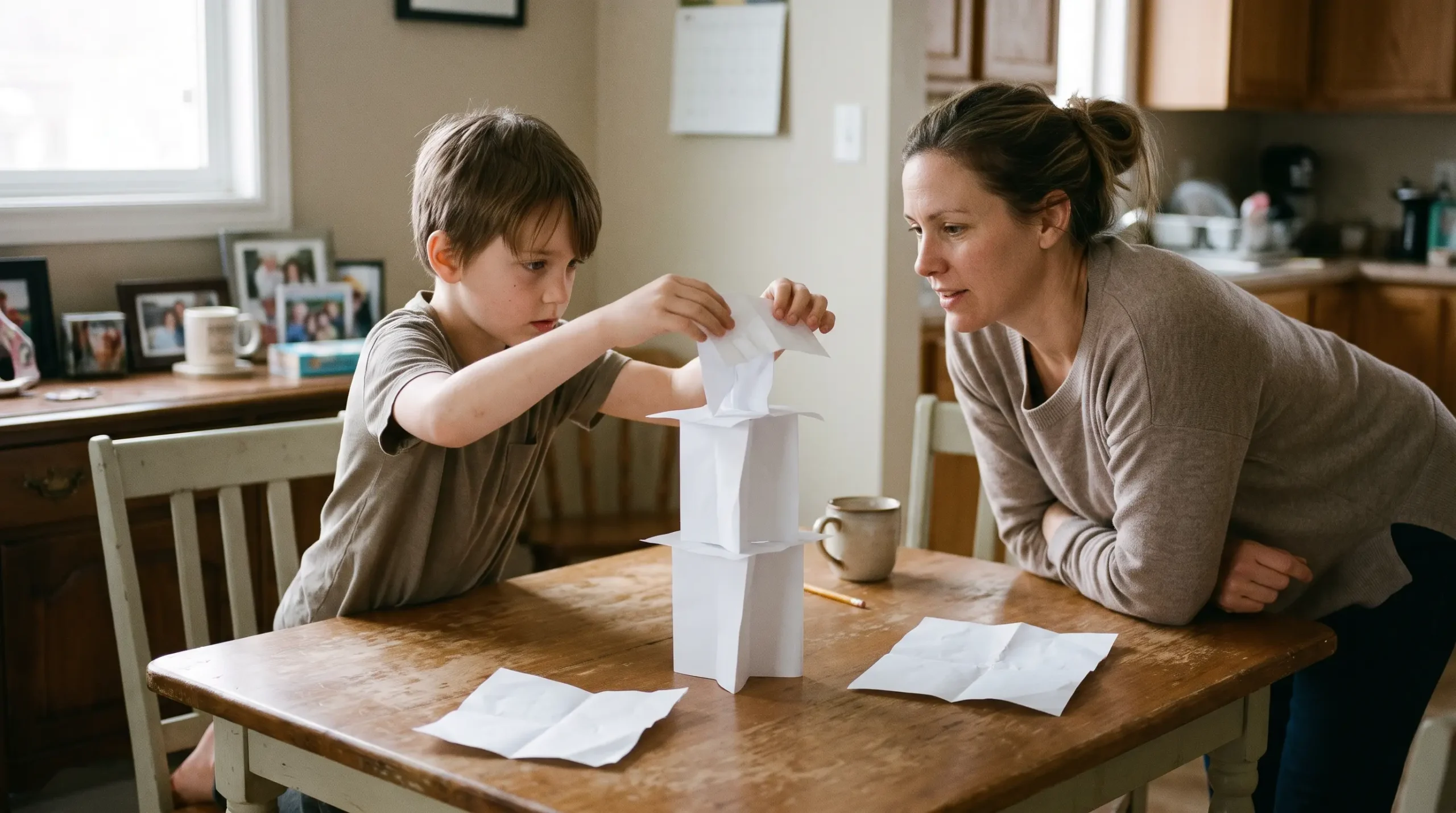
- Build a paper tower — 8 minutes. Set out three sheets of paper and ask, “How tall can we make these stand without tape?” Try folding one sheet into a wide base while your child experiments with another. If the tower collapses, compare what held and what didn’t rather than declaring a winner.
- Create a three-clue treasure hunt — 8 minutes. Hide a familiar object in one safe, easy-to-reach spot, then give three clues from broad to specific: “It’s in this room … near something soft … under the blue cushion.” Let your child give you a turn if there’s time. Skip inaccessible hiding places or small objects for young siblings.
- Play mystery sound detective — 4 minutes. Ask your child to close their eyes if comfortable, then crumple a piece of paper or tap a spoon gently against a wooden table. Can they identify the sound? Switch roles. A child who dislikes surprise noises can watch first and choose the sounds.
- Make a ridiculous commercial — 7 minutes. Hold up a clean sock and announce, “Presenting the world’s first rocket-powered sock!” Your child gets to invent what it does and set the price, while you become a very curious customer. You only need one absurd invention.
- Draw a two-person comic strip — 9 minutes. Fold a page into three panels. Your child draws the opening, you add an unexpected middle, and you decide on the ending together. Stick figures are fine. If time runs out after two panels, the cliffhanger can be part of the joke.
Low-effort variation: If your child wants your company but not a full activity, sit beside them while they work on the tower or comic. Ask whether they’d like you to help, watch, or simply be there.
Small Conversations That Don’t Feel Like an Interview
A conversation can start with something you offer about yourself, rather than a string of questions about school. Leave room for silence or a short answer.
- Share one tiny good moment — 3 minutes. Start with a real detail: “A dog in a raincoat made me smile today.” Then say, “Anything odd or nice happen around you?” A shrug is allowed; you have still shared a moment from your day.
- Let your child interview you — 5 minutes. Say, “You can ask me one question about when I was your age.” Answer with an actual memory, including something funny or imperfect, rather than a moral lesson. If they ask a second question, follow their curiosity.
- Play ‘Which would you choose?’ — 4 minutes. Offer a harmless choice: “A picnic in the mountains or one by the sea?” After they answer, share your own reason and let them invent a stranger choice. There’s no correct answer and no need to defend a preference.
- Revisit one favorite photograph — 6 minutes. Find one picture from something you experienced together. Instead of asking your child to remember a date, say, “I remember the wind that day. What do you remember?” Enjoy the detail they notice, even if it’s entirely different from yours.
- Give a two-word mood report — 3 minutes. Go first: “Tired, hopeful.” Invite your child to offer two words, a gesture, or nothing at all. Don’t ask them to justify the answer. If they share a hard feeling, acknowledge it rather than rushing to improve their mood.
- Watch the world together — 5 minutes. Sit by a window or in another safe spot and notice something outside: moving clouds, birds, people walking past. You might say, “That cloud looks like a hat,” then be quiet. This one works even when nobody wants to talk.
If a brief comment turns into your child sharing something important, stop treating it as a timed game and listen if you can. Our separate guide on listening to your child without fixing every problem focuses on what to do when a child needs to be heard.
Move, Laugh, and Explore Together
For children who prefer moving to talking, a shared activity can take the pressure off conversation. Use a comfortable space and adapt movements for your child’s abilities and sensory preferences.
- Try a sock-ball basket toss — 5 minutes. Roll a pair of clean socks into a soft ball and place an empty laundry basket nearby. Take turns tossing from any comfortable distance. Let your child move the basket or change the rules; misses can be the funniest part.
- Make shadow shapes — 6 minutes. Find a safe sunny patch and try making tall, tiny, or animal-shaped shadows together. Ask, “Can we make one giant creature with both our shadows?” An indoor lamp and a plain wall can work if outdoor space isn’t practical.
- Go on a three-detail nature hunt — 8 minutes. Look for one pattern, one sound, and one color in a safe yard or nearby area. Try “a line on a leaf,” “a bird call,” and “something yellow.” If you can’t go outside, use a window view. Observe without touching unknown plants or animals.
- Create a five-move stretch chain — 5 minutes. Start with a comfortable reach; let your child add the second movement and alternate until you have five. Repeat the silly sequence once. Seated or smaller movements count, and nobody needs to push into painful stretches.
- Play freeze dance — 6 minutes. Play a familiar song and invite your child to control when the music pauses. When it stops, freeze in an exaggerated pose. If loud music or sudden stops are unpleasant, use a quiet beat and a visible hand signal instead.
- Give the plants a drink together — 8 minutes. Check one or two safe houseplants and see whether the soil actually needs watering. Let your child notice leaf shapes or help pour a small, premeasured amount. If the plants don’t need water, simply look at what has changed since last time; this isn’t a chore test.
Most of these can be scaled down to two minutes or done while seated. The shared attention matters more than movement, scores, or finishing every step.
Easy Connection Ideas for Tweens and Teens
Older children may feel more comfortable with a casual invitation than a planned “bonding activity.” Ask once, keep your curiosity genuine, and let them choose how much to share. Their privacy and independence matter.

- Exchange one favorite song — 8 minutes. Try, “Want to play me a song you’ve been into lately?” Listen without teasing the lyrics or criticizing the genre. Share one of yours only if they’re interested. Even a short clip is enough.
- Let them show you their current hobby — 7 minutes. Ask, “Can you show me one thing you’ve been working on?” It might be a sketch, a game strategy, or a sports move. Let them be the expert; you don’t have to fully understand the hobby to take it seriously.
- Create a two-photo story — 8 minutes. Each of you photographs an ordinary object nearby, such as a shoe and a plant, then invents a one-sentence plot connecting them. No selfies or posting required. If either person dislikes photography, just pick two objects and make up the story aloud.
- Make a funny prediction — 6 minutes. Predict something harmless about the coming week: which meal you’ll both want again or whether the household plant will grow a new leaf. Compare predictions, laugh, and leave the outcome for later. Avoid making predictions about someone’s grades or behavior.
- Assemble a quick snack together — 10 minutes. Make a simple no-cook snack side by side. Let your tween choose between two easy ingredients while you take the other small task. The conversation can be about nothing in particular; check allergies and supervise equipment as appropriate.
- Join one round of their game — 10 minutes. Say, “Could you teach me one round?” Whether it’s a card game, a board game, or an age-appropriate video game, let your child explain the rules. Choose something that can pause or end naturally within the time you have; respect your existing screen-time boundaries.
The Raising Children Network’s guidance for staying connected with teens recommends making use of brief, ordinary opportunities and finding ways to spend time together that teens are comfortable with. A declined invitation doesn’t have to become a discussion about the relationship.
Pick the Right Idea for the Moment
When you’ve only got a few minutes, don’t scan the entire list. Match the invitation to what your child seems to need:
- “I want to show you something!” Try the three-toy tour (6) or hobby demonstration (26). Let them lead.
- Restless or full of energy? Try sock toss (19), shadow shapes (20), or freeze dance (23).
- Quiet or worn out? Sit by the window (18), look at one picture (16), or listen to a song (25). Talking can be optional.
- Wanting to invent something? Try the stuffed-animal clinic (2), paper tower (8), or silly commercial (11).
- Only two minutes free? Do one round of the mirror game (1) or share a two-word mood (17). You don’t have to use the whole suggested time.
If you’d rather choose from a wider range of activities, the Free Screen-Free Activity Picker for Families is a separate tool. For a longer planned activity with the household, see How to Plan a Screen-Free Family Evening Without Complaints.
What If Your Child Says No—or the Ten Minutes End?
Try a light invitation such as “Want to help me invent a silly creature for five minutes?” If your child says no, don’t turn the invitation into a test of affection. You might say, “No problem. I’m here if you change your mind,” and carry on. Sometimes a child wants a little space; sometimes they prefer sitting beside you without an activity.
If you need to leave after a few minutes, be clear from the start: “I’ve got about five minutes before dinner. Want to build one part of the tower with me?” When the time is up, acknowledge what you shared: “I liked how you figured out that base. We can save the rest for another day.” If your child has begun telling you something serious, respond to that need rather than ending abruptly because a timer went off.
Adapt the ideas for your child’s communication, mobility, sensory needs, and comfort with touch, sounds, or photographs. Ten minutes is the upper limit for this idea list, not a magic number or a promise that one activity will change your relationship.
And if your goal is to make individual time possible when you have more than one child, How to Build One-on-One Time With Each Child covers the scheduling question separately.
Pick one small invitation today. It might last three minutes, be mostly silent, or end in a laugh that neither of you expected. It doesn’t need to become a routine, a lesson, or a performance to be worth sharing.
I found the best way was to draw with my daughter. This creates a real and strong connection between us and has been truly beneficial for us. Thank you.