
How to Apologize to Your Child After You Lose Your Temper
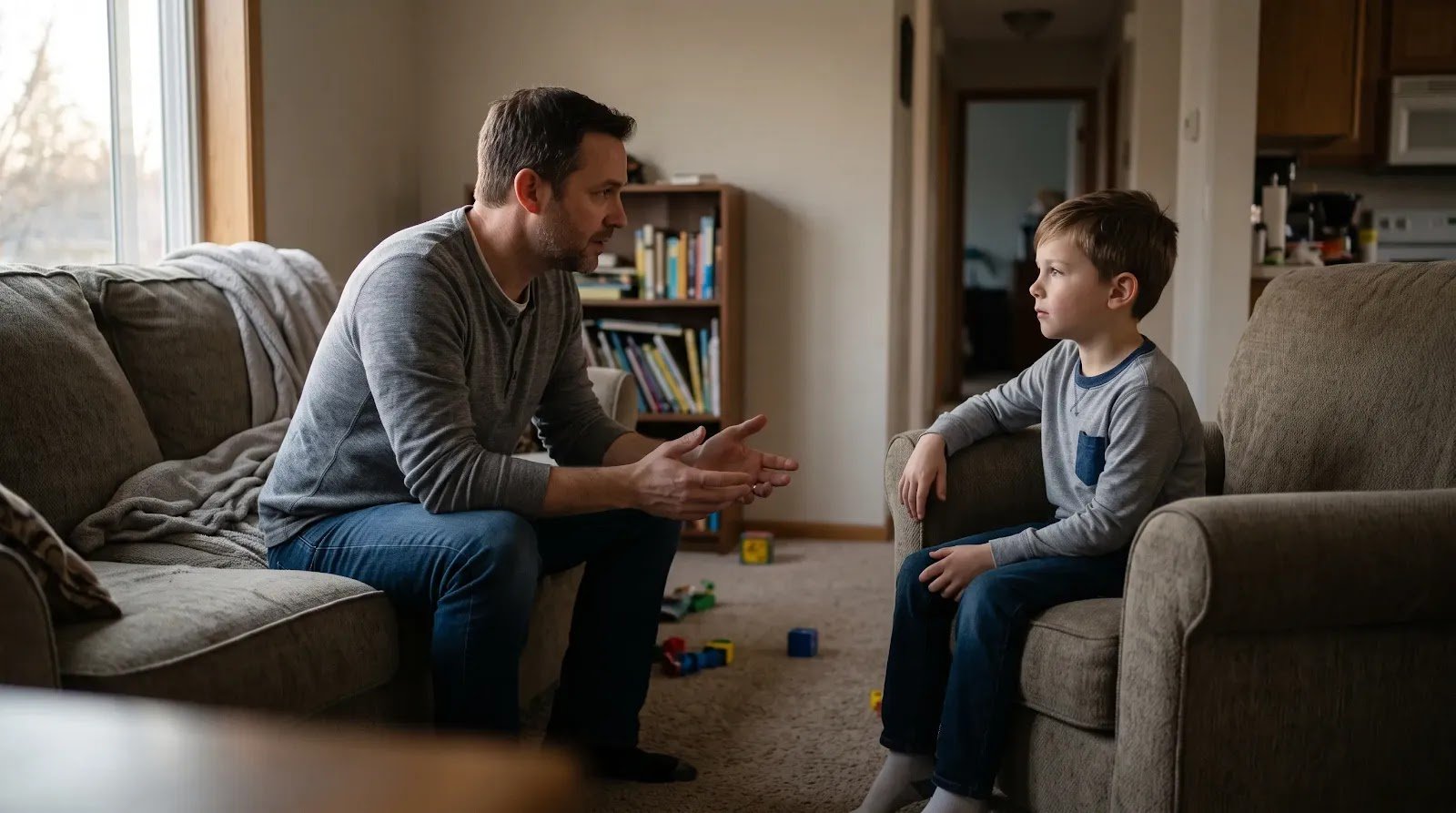
“I’m sorry I yelled, but you weren’t listening.”
It sounds like an apology.
To a child, it can sound more like:
“I yelled because of you.”
If you lost your temper, the repair does not need to be long or dramatic. It does need to be clear enough that your child does not have to figure out which part you are actually taking responsibility for.
A useful apology can often fit into four parts:
Name what you did. Own it. Keep the original boundary separate. Say what you will try differently next time.
You are not trying to erase the conflict or make your child instantly happy with you.
You are showing what responsibility looks like after an adult gets something wrong.
Wait Until You Can Apologize Without Restarting the Fight
You have just shouted.
You immediately feel bad.
So you rush back with:
“I’m sorry, okay? But you need to understand why I got so angry.”
Now you are explaining louder.
The apology can wait a few minutes.
Make sure everyone is safe, then get calm enough that you can speak without trying to win the original argument.
The CDC’s current emotion-coaching guidance recommends that caregivers notice and manage their own emotions, pause when needed, and wait until both parent and child are calm enough to reconnect constructively.
The American Academy of Pediatrics gives similar advice when parents feel out of control: cool down before returning to the interaction.
You do not need to become perfectly serene.
You do need to be calm enough that “I’m sorry” will not turn into round two.
Part 1: Name Exactly What You Did
Start with the behavior that belongs to you.
“I yelled at you.”
“I spoke to you in a really harsh voice.”
“I called you a name, and that was not okay.”
“I slammed the door when I was angry.”
Avoid vague apologies such as:
“Sorry about earlier.”
or:
“Sorry things got crazy.”
Your child should not have to guess whether you are apologizing for yelling, for setting the limit, or simply for the fact that everyone had an unpleasant evening.
HealthyChildren.org’s AAP guidance on family communication specifically recommends modeling full apologies and gives parents the example of directly acknowledging that they yelled.
Part 2: Own It Without Making Your Child the Cause
This is where many apologies accidentally disappear.
Compare:
“I’m sorry I yelled, but you kept ignoring me.”
with:
“I was frustrated because I had asked several times. I still should not have yelled at you.”
The second version can acknowledge the context without transferring responsibility.
Your child may have behaved poorly.
You may have been exhausted.
You may have repeated yourself six times.
Those facts can be discussed.
They do not need to become:
“You made me yell.”
A child is responsible for their behavior.
An adult is responsible for theirs.
The “But” Check: If everything after “I’m sorry, but…” explains why your child caused your behavior, stop before the “but.” Discuss the child’s behavior separately.
Part 3: Keep the Boundary Separate From the Apology
Suppose your child was throwing a toy after you told them to stop.
You lost your temper and shouted.
You do not have to say:
“I’m sorry I told you to stop.”
The safety limit may have been completely appropriate.
Try:
“I was right to stop you from throwing the toy. I was not right to yell at you the way I did.”
Or:
“The rule about turning the game off still stands. I should have spoken to you without shouting.”
This distinction matters because parents sometimes avoid apologizing out of fear that the child will think the original rule disappeared.
It does not have to.
You can repair your delivery while keeping a reasonable limit.
The AAP’s positive-discipline guidance recommends calm, teaching-focused discipline and advises parents who make a mistake in the heat of the moment to cool down, apologize, and explain how they intend to handle the situation differently next time.
Part 4: Say What You Will Try Differently
An apology becomes more meaningful when your child can picture what “different” means.
Avoid:
“I promise I’ll never get angry again.”
That is probably unrealistic.
Try:
“If I feel myself getting that angry again, I’m going to pause before I keep talking.”
Or:
“Next time I need you to get ready, I’m going to give you one clear instruction instead of getting louder and louder.”
Or:
“I need to stop the conversation when I’m that upset and come back when I can speak respectfully.”
Keep the promise small enough that you can actually practice it.
Children learn something important when adults do not just admit mistakes—they adjust after them.
Put the Four Parts Together
You do not need a speech.
For example:
“I’m sorry I yelled at you when we were getting ready for school. I was frustrated, but yelling was my choice and it wasn’t okay. We still do need to leave on time. Tomorrow, if I’m getting overwhelmed, I’m going to stop and give you one direction at a time instead of shouting.”
That apology does four jobs:
- It says what happened.
- It takes responsibility.
- It does not erase the expectation.
- It identifies a next step.
Then stop talking.
You do not need to turn the apology into a ten-minute lesson on why the morning was difficult.
Do Not Ask Your Child to Make You Feel Better
You apologize.
Your child says:
“Okay.”
No hug.
No:
“I forgive you, Mom.”
No movie-scene reconciliation.
That can feel uncomfortable.
Let it.
Avoid:
“Are you still mad at me?”
“You know I love you, right?”
“Can I have a hug?”
when those questions are really requests for reassurance.
Your child may want affection. Offer it naturally if that fits your relationship, but do not make accepting physical closeness the proof that your apology worked.
You are responsible for giving the apology.
Your child gets some room to have their own reaction.
Let Your Child Tell You How It Felt
After you apologize, your child may say:
“You scared me.”
Or:
“You always yell.”
Or:
“I thought you hated me.”
Your instinct may be to correct immediately:
“I don’t always yell.”
“Of course I don’t hate you.”
“You weren’t scared—you were yelling too.”
Start by listening to what the child is trying to communicate.
You might say:
“My yelling felt scary to you.”
or:
“You felt like I was really angry with you as a person, not just upset about what happened.”
You can clarify facts if needed later.
The apology is a poor time to cross-examine the child’s description of their own experience.
Do Not Turn Your Apology Into Your Child’s Apology
Another common pattern:
“I’m sorry I yelled. Now what do you need to say to me?”
Your child may indeed owe an apology.
Maybe they insulted you.
Maybe they hit a sibling.
Maybe they broke a rule.
But attaching their apology as the price of yours changes the message.
Handle the two responsibilities separately.
You can say:
“I’m responsible for apologizing for yelling. We still need to talk about what happened with your brother, but those are two separate things.”
This also models the same principle children need when learning to take ownership of their mistakes: responsibility is not cancelled because someone else also behaved badly.
Our guide to talking to kids about mistakes without shame goes deeper into separating behavior from identity when a child is the one who made the mistake.
Change the Apology With Your Child’s Age
Toddlers and Preschoolers
Keep it concrete and short.
“I yelled loudly. That wasn’t okay. I’m sorry. I’m calm now.”
A long explanation may create more confusion than clarity.
Young children also learn heavily from what happens next: your calmer voice, safe presence, and more regulated behavior matter.
CDC guidance for toddlers and preschoolers emphasizes that caregivers model self-regulation through their own behavior and should return to interaction once they can respond calmly.
Elementary-Age Children
You can add the reason without turning it into an excuse:
“I was worried we were going to be late, and I yelled. Being worried doesn’t make yelling okay. Next time I’m going to pause and tell you clearly what I need you to do.”
Give them space to tell you what the moment was like from their side.
Tweens and Teens
Do not make the apology childish or overly emotional.
Be direct.
“The way I spoke to you earlier was disrespectful. I was angry, but that doesn’t excuse it. I’m sorry. I expect us both to speak respectfully, and that includes me.”
Older children may not want to process the whole conflict immediately.
Let a sincere apology stand without requiring a long conversation on your schedule.
Do Not Apologize for Every Firm Parenting Moment
An apology is appropriate when you did something you believe was wrong or harmful in the interaction.
It is not necessary simply because your child disliked a boundary.
You do not need to apologize for:
“No, you can’t hit your brother.”
“The phone stays downstairs tonight.”
“We are leaving the park now.”
when those limits were communicated appropriately.
You can empathize:
“I know you’re disappointed.”
without converting every uncomfortable parenting decision into an adult mistake.
This helps keep apologies meaningful.
If You Keep Apologizing for the Same Thing, Change the Pattern
“I’m sorry I yelled.”
Monday.
Wednesday.
Friday.
At some point, the problem is no longer the wording of the apology.
Look for the moment before you lose control.
Is it always during the morning rush?
After the fifth repeated instruction?
At bedtime when everyone is exhausted?
When you are already overloaded by something unrelated?
An apology repairs the interaction.
A system change may reduce how often you need the same repair.
If yelling has become part of the pattern when you are trying to get cooperation, see how to get kids to listen without yelling for strategies focused specifically on that cycle.
After the Apology, Let Reconnection Be Ordinary
You do not need to create a special outing to prove everything is okay.
Return to normal warmth.
Read the bedtime story.
Make dinner.
Ask about the game they were playing.
Sit nearby.
Let the relationship move forward without pretending the conflict never happened.
If the whole day has felt disconnected—not just one moment that needs an apology—our guide to reconnecting with your child after a hard parenting day focuses on rebuilding connection more broadly.
When Losing Your Temper Is Becoming More Serious
There is a meaningful difference between occasionally raising your voice and a pattern of frightening or harmful behavior.
The AAP advises against harsh verbal discipline such as yelling or shaming and against physical punishment. Its discipline guidance emphasizes teaching and positive behavior strategies instead.
If you frequently lose control, your child appears afraid of you, you regularly use insults or threats, or anger is escalating rather than improving, do not rely on better apologies alone.
Seek appropriate support from a pediatrician, your own healthcare professional, a qualified mental health professional, or another relevant family support resource.
If you think you might physically hurt your child, prioritize immediate safety: create distance when it is safe to do so, make sure your child is with a safe caregiver if possible, and seek urgent local help.
An apology is part of responsibility.
Preventing the next harmful incident is part of responsibility too.
A Good Apology Does Not Make You Less of the Parent
You can say:
“I was wrong to yell.”
and still say:
“The rule stands.”
You can listen to how your child felt without making them responsible for your guilt.
You can admit that you handled one moment badly without turning yourself into the bad person in the story.
And you can show your child something they will eventually need in their own relationships:
When you hurt someone, you do not defend the hurt just because you were angry.
You name what you did.
You own it.
You repair what you can.
Then you try to behave differently the next time.