
How to Build a Morning Routine That Gets Kids Out the Door on Time
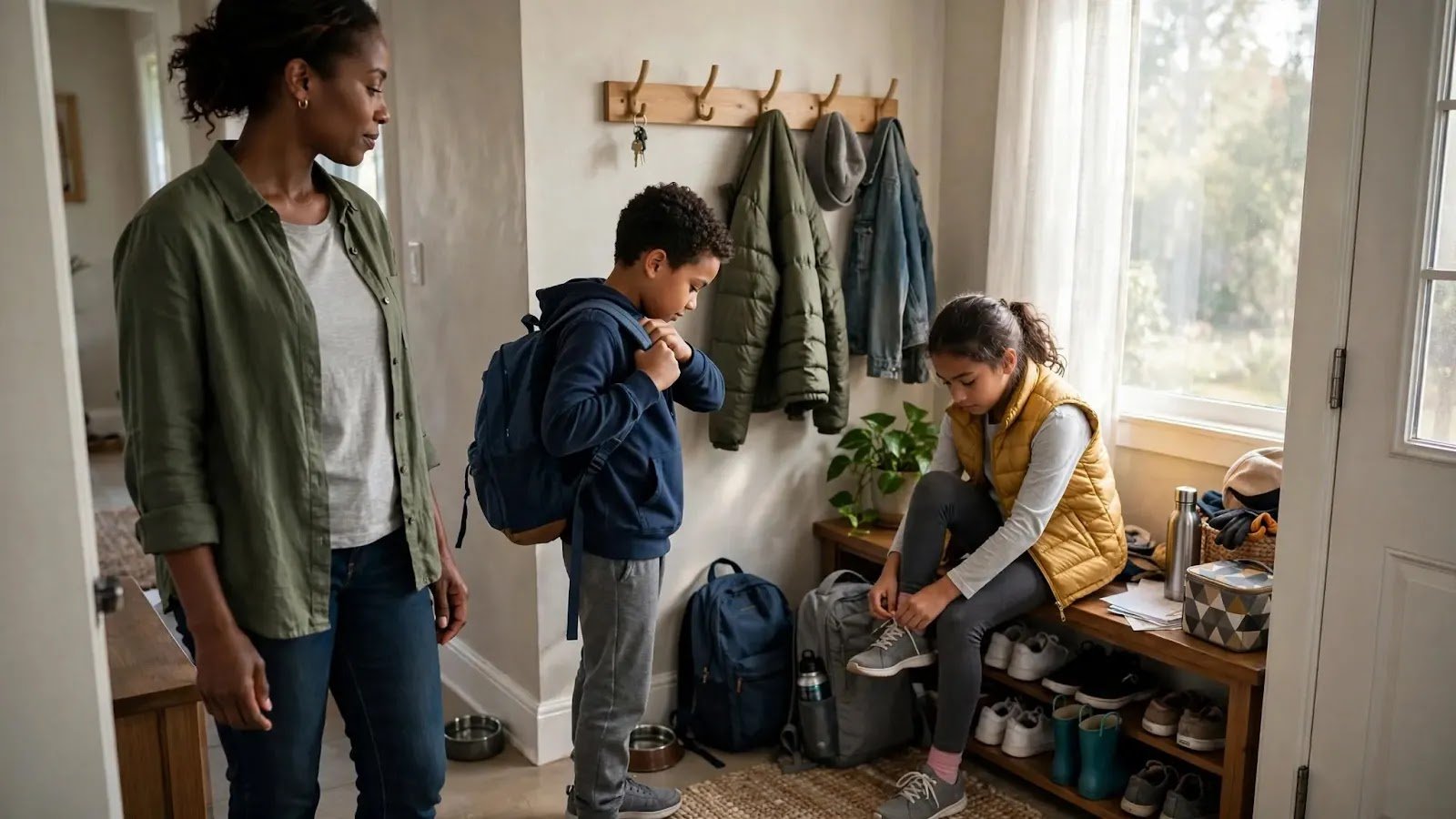
Most rushed school mornings are not really a speed problem. They are a friction problem: too many decisions, too many missing items, and too many instructions packed into the short stretch between waking up and walking out the door.
A useful morning routine removes as much of that friction as possible. Start with the time your family actually needs to leave, work backward, move predictable decisions to the night before, and keep the essential morning steps simple enough for kids to learn.
Work Backward From the Door
Instead of choosing a wake-up time first and hoping everything fits, begin with the non-negotiable part of the morning: when everyone needs to leave.
If the family must be out the door at 7:50 a.m., a rough plan might look like this:
- 7:50: Leave.
- 7:40: Shoes, coats, backpacks, and final bathroom trip.
- 7:25: Teeth, hair, and other personal care.
- 7:05: Breakfast.
- 6:55: Get dressed.
- 6:45: Wake up.
The exact times will differ by family and age. What matters is seeing whether the routine you expect can actually fit into the time available.
Then add some margin. If every minute has to go perfectly for you to arrive on time, the schedule is too tight. A spilled drink, missing shoe, slow zipper, or forgotten school item should not immediately turn into a crisis.
Fix the Delay That Keeps Happening
Before adding more rules, notice where your mornings repeatedly lose time.
Maybe breakfast stretches too long. Maybe clothes are chosen at the last minute. Maybe your child gets dressed and then disappears into play. Maybe five minutes vanish every morning while somebody searches for a water bottle or homework folder.
Fix that repeated bottleneck first.
If backpacks are the problem, give them one permanent home. If clothing creates arguments, choose it the night before. If breakfast choices take too long, narrow weekday options.
A good routine does not make the family better at rushing. It removes reasons to rush.
Move What You Can to the Night Before
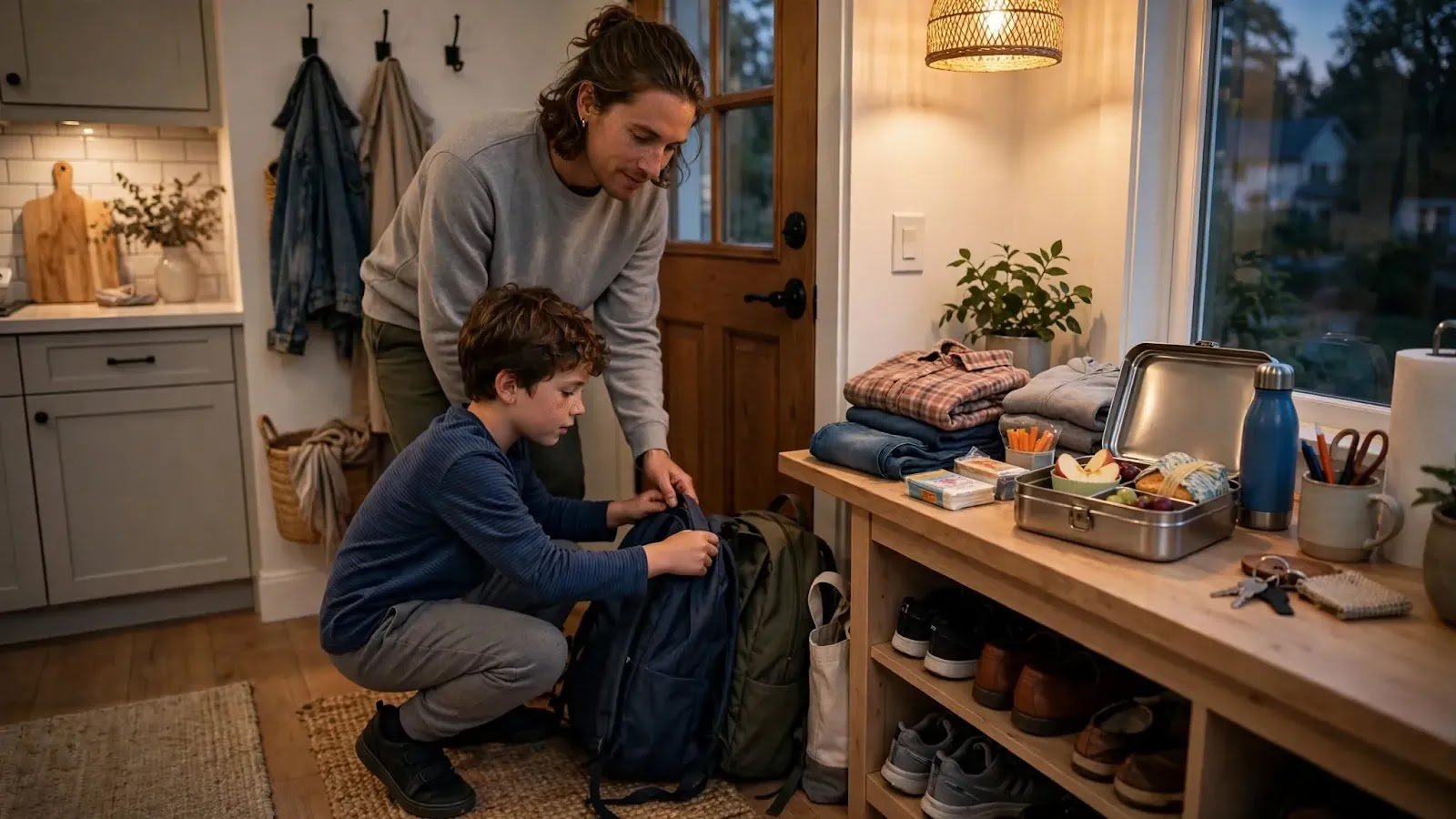
Anything that does not truly need to happen after waking up is worth considering the evening before:
- Choose clothes.
- Pack backpacks and school papers.
- Charge school devices.
- Prepare lunch components or snacks.
- Place sports, music, or activity bags near the exit.
- Check the next day’s weather and needed outerwear.
HealthyChildren.org from the American Academy of Pediatrics similarly recommends putting as many things in order as possible the night before to help weekday mornings run more smoothly.
You do not need an elaborate evening preparation ritual. Move the two or three things that repeatedly slow your own family down.
Give Morning Essentials One Home
A backpack should not need to be rediscovered every weekday.
Create one small “launch spot” near the exit—a hook, bench, basket, cubby, or part of a closet—for the things that regularly leave with your family.
Depending on your household, that may include backpacks, lunchboxes, shoes, coats, sports bags, instruments, or anything that must go to school the next day.
Keep the setup usable by the child who is supposed to use it. A reachable backpack hook is more valuable than a beautiful organization system that only an adult can maintain.
Keep the Steps Predictable, Not Complicated
Children are more able to follow a routine when the major steps happen in roughly the same order each day.
For example:
- Wake up and use the bathroom.
- Get dressed.
- Eat breakfast.
- Brush teeth and finish personal care.
- Add refrigerated items to the backpack.
- Put on shoes and outerwear.
- Leave.
Your sequence may look completely different. Consistency matters more than copying someone else’s checklist.
The CDC’s guidance on routines and structure, which focuses on toddlers and preschoolers, notes that predictable routines help young children know what to expect. The same practical principle can be adapted as children get older.
Predictable also does not mean rigid. Field trips, appointments, sick days, early meetings, and forgotten projects happen. The routine should make ordinary mornings easier, not make the family feel that the day has failed whenever something changes.
Reduce Decisions During the Rush
Choices can be useful. Too many open-ended choices before school can become another delay.
If clothing regularly causes conflict, choose it the night before. Instead of asking, “What do you want for breakfast?” when you have ten minutes, offer two realistic choices that are already available.
The goal is not to control every detail. It is to save bigger decisions for times when there is actually room to make them.
Let Kids Learn Their Part of the Routine
A routine works better when one adult does not have to act as the family’s morning control tower forever.
Give children responsibility for steps that fit their age and abilities. A younger child might put pajamas in the hamper and bring a backpack to the door. A school-age child may be able to dress independently, fill a water bottle, or check that homework is packed. Older children can gradually manage more of the sequence themselves.
Teach a new responsibility when nobody is rushing. Walk through it on an evening or weekend, show where things belong, and practice the order before expecting independence on a busy school morning.
A visual routine can also reduce the need to verbally deliver the same list every day. The Free Family Routine Builder can help you turn your own morning steps into a simple sequence that fits your household.
Replace Constant Reminders With Useful Cues
There is a difference between helping a child stay on track and narrating every minute of the morning.
Instead of:
“Get dressed. Did you get dressed? Find your socks. Eat breakfast. Hurry up. Brush your teeth. Where is your backpack?”
Try pointing back to the routine:
“You’re dressed. What’s next?”
Or simply:
“Breakfast is next.”
Some children will need more prompting, especially while the routine is new. The aim is gradual familiarity—not expecting independence overnight.
If repeated instructions are turning into yelling rather than a routine problem, how to get kids to listen without yelling addresses that part of the morning separately.
If Waking Up Is the Main Problem, Look at the Night Before
No checklist can make an exhausted child feel well rested.
If getting out of bed is consistently the hardest part of the morning, look at bedtime as well as wake time. AAP guidance on children’s sleep recommends making adequate sleep a family priority and keeping regular daily routines, including consistent waking times.
If evenings themselves are unpredictable, you may want to build a bedtime routine kids can actually follow rather than trying to solve tired mornings entirely after the alarm goes off.
Persistent difficulty waking, significant daytime sleepiness, loud snoring, or breathing concerns during sleep are worth discussing with your child’s pediatrician.
When the Morning Is Already Off Track
Even a good routine occasionally collapses. When you realize you are behind, stop trying to rescue the “perfect” morning and protect the essentials instead.
- Drop tasks that can safely wait.
- Use short, specific directions.
- Help with a task your child normally does independently if today requires it.
- Do not add unrelated chores during the final minutes before leaving.
- Notice what caused the delay and adjust the system later.
If the same problem keeps happening, treat it as information. Move the task earlier, simplify it, prepare it the night before, or change who is responsible for it.
A Simple Morning Routine to Start With
If your current mornings feel chaotic, resist the urge to design an elaborate schedule. Start with a basic version:
- Night before: Prepare clothes, backpacks, papers, lunch items, and anything unusual needed tomorrow.
- Wake up: Use a reasonably consistent wake time.
- Get dressed: Finish this before play or other distractions when that works better for your child.
- Breakfast: Keep weekday choices manageable.
- Personal care: Bathroom, teeth, hair, and other essentials.
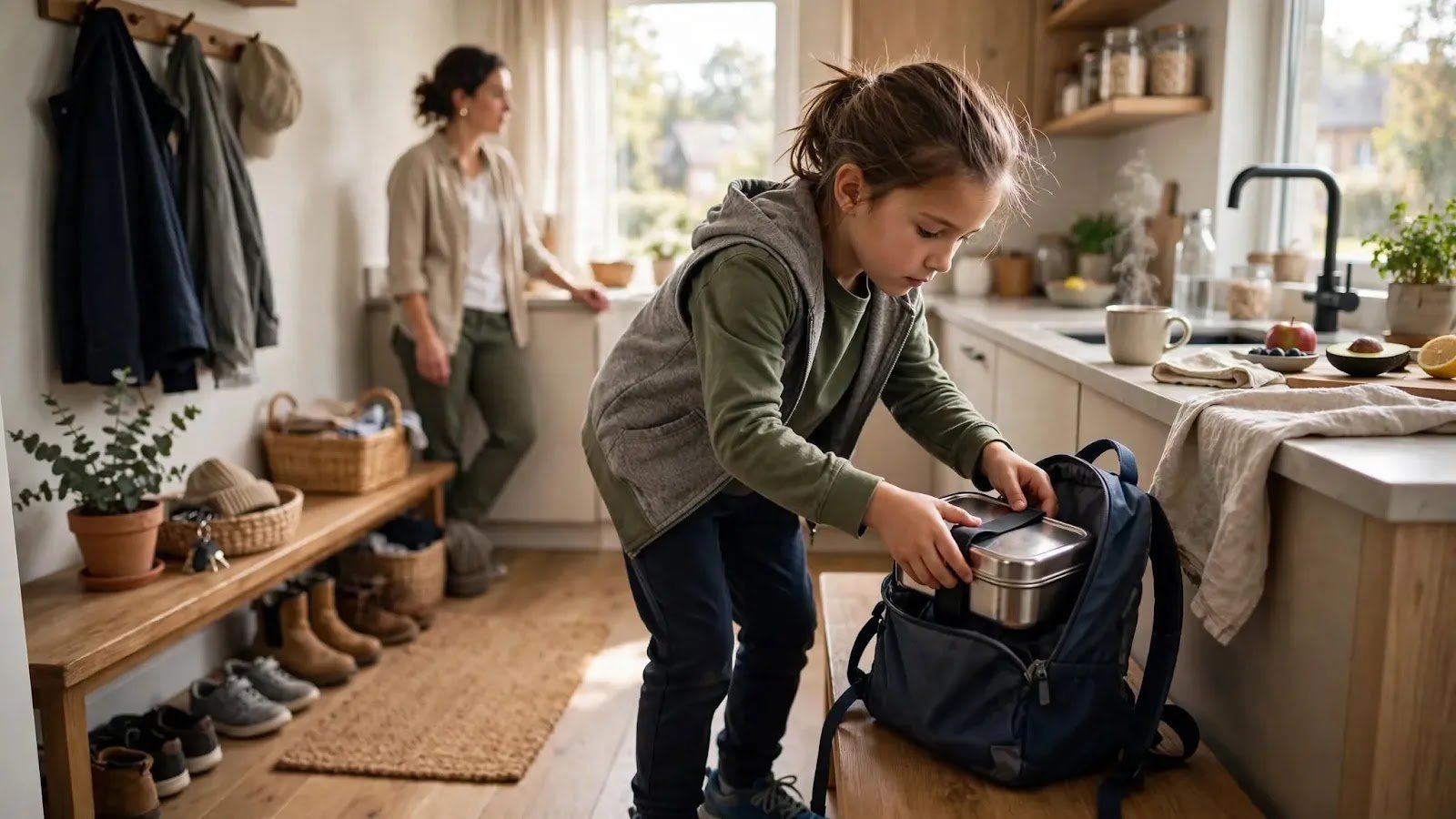
- Final pack: Add lunchboxes, water bottles, or refrigerated items.
- Launch spot: Collect backpack, shoes, coat, and special equipment.
- Buffer: Leave a little room for something unexpected.
- Go: Once everyone is ready, protect the departure time instead of adding another task.
Run the simple version long enough to discover what your family actually needs before adding more detail.
A calmer morning usually comes from removing friction, not from telling everyone to move faster. When belongings have a home, decisions happen earlier, the steps are familiar, and kids gradually learn their part, getting out the door can require far less managing—even when the morning is not perfectly smooth.