
How to Create a Simple Family Cleaning Routine
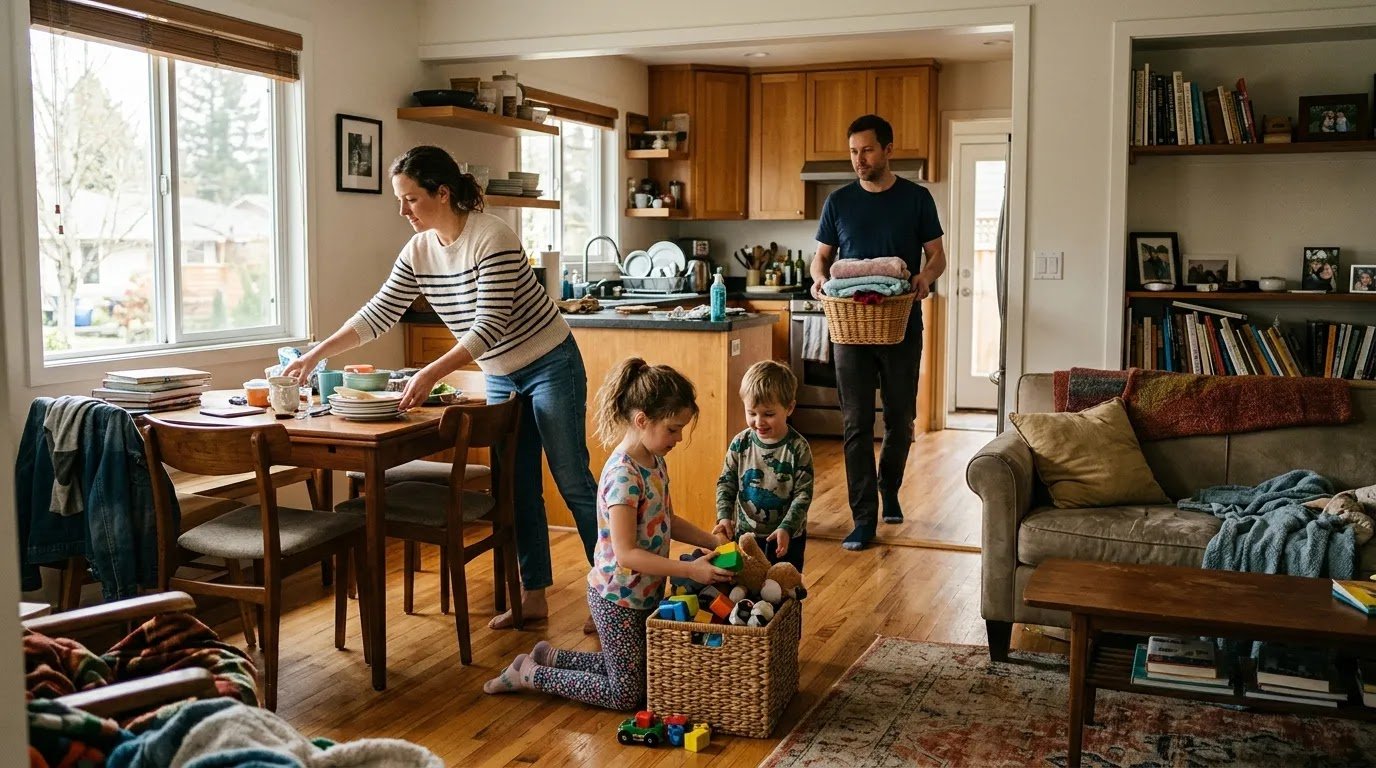
If your cleaning routine only works on a Saturday when nobody has plans, nobody is tired, and everyone suddenly feels motivated to clean the house, you probably do not have a routine yet.
You have a cleaning event.
A useful family cleaning routine needs to survive ordinary life: school, work, dinner, activities, forgotten laundry, and people making new messes while somebody else is cleaning the old ones.
The goal is not a spotless house.
It is a home that regularly returns to a manageable baseline.
A simple way to build that is:
Clean-Enough Line → Daily Reset → Weekly Rotation → As-Needed Jobs.
Start With Your Clean-Enough Line
Before making a cleaning schedule, ask:
“What actually starts making our home harder to use when we ignore it too long?”
For your family, that might mean:
- The kitchen is usable for the next meal.
- Main walkways stay reasonably clear.
- Dirty clothes make it into hampers.
- The bathroom gets basic regular cleaning.
- Trash does not overflow.
- Frequently needed items can usually be found.
That is much more useful than:
“The whole house should always look clean.”
Your clean-enough line gives the routine a finish line.
Build the Routine in Three Layers
Not every cleaning job belongs on the same schedule.
Separate them into:
1. Daily Reset: small jobs that keep the house functioning.
2. Weekly Rotation: maintenance jobs that do not need daily attention.
3. As-Needed List: larger or occasional jobs that can wait until they actually matter.
This prevents Saturday from becoming the collection day for every household task that did not happen all week.
Layer 1: Keep the Daily Reset Small
A daily reset is not a daily deep clean.
It is a short return to your clean-enough line.
A family reset might include:
- Handle dishes after dinner.
- Clear enough kitchen space for tomorrow.
- Return obvious clutter to its main home.
- Move dirty clothes toward hampers.
- Take out trash if needed.
- Put tomorrow’s frequently needed items where they belong.
Some homes may need ten minutes.
Others may need twenty.
The exact number matters less than keeping the routine short enough to repeat on normal days.
HealthyChildren.org’s guidance on family routines notes that predictable routines help children know what comes next and includes cleanup and household chores as part of ordinary evening family life.
Attach the Reset to Something That Already Happens
“We’ll clean sometime tonight” is easy to postpone.
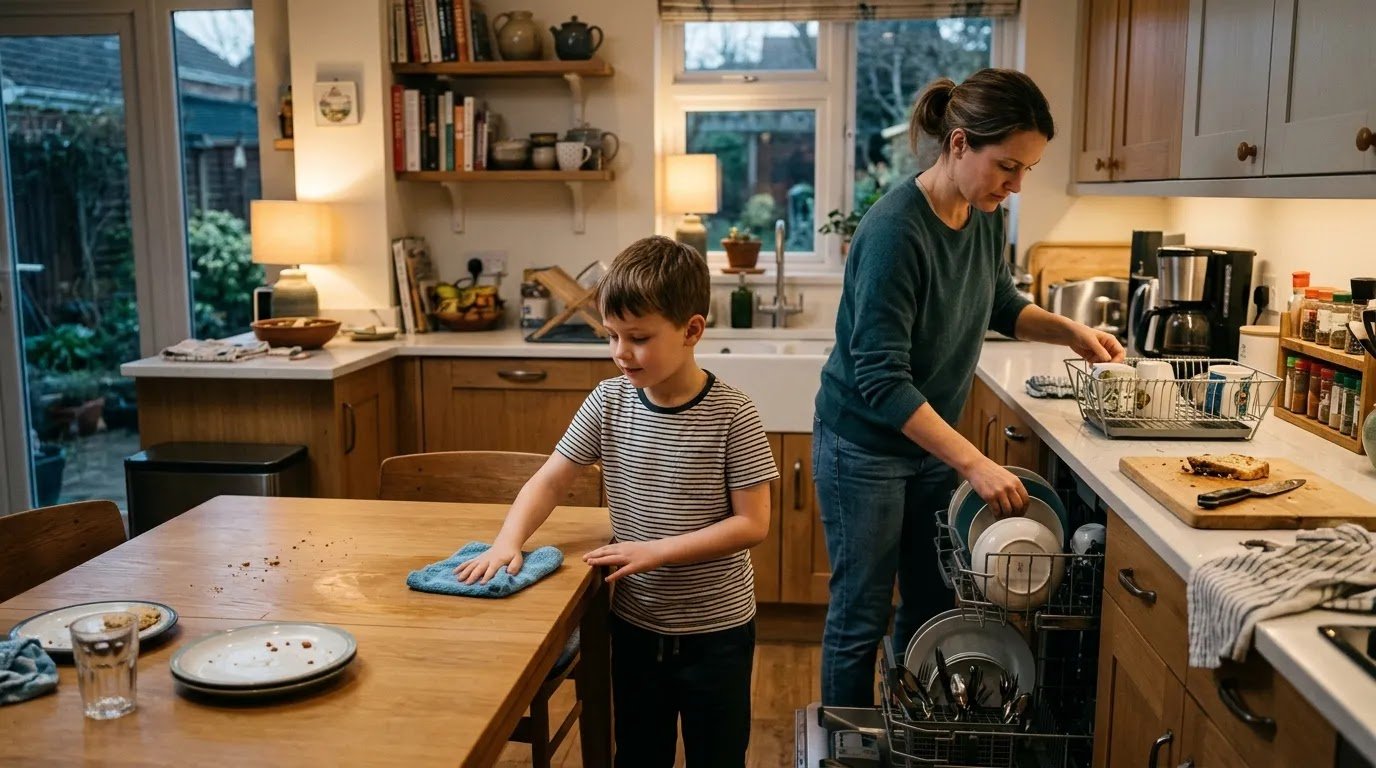
Give the reset a predictable trigger:
After dinner → kitchen reset.
Before bedtime → toys return to baskets.
After school clothes come off → hamper or closet.
Before weekend screen time → quick shared-space reset.
You are linking the cleaning job to an event that already happens instead of waiting for somebody to notice the clock or feel motivated.
If your family needs those steps visible instead of stored in one person’s head, the Free Family Routine Builder can turn them into a simple repeatable sequence.
Layer 2: Rotate the Bigger Jobs
The daily reset protects basic function.
Weekly cleaning handles the jobs that do not need attention every evening.
For example:
- Monday: bathroom basics.
- Tuesday: vacuum main shared spaces.
- Wednesday: no extra cleaning or a catch-up slot.
- Thursday: sheets or bedroom maintenance.
- Friday: light kitchen maintenance if needed.
- Weekend: one larger job, not every unfinished job.
This is only an example.
A family with sports on Tuesdays should not assign Tuesday its hardest cleaning job just because a schedule online says so.
The right rotation fits your actual week.
Choose One Weekly System
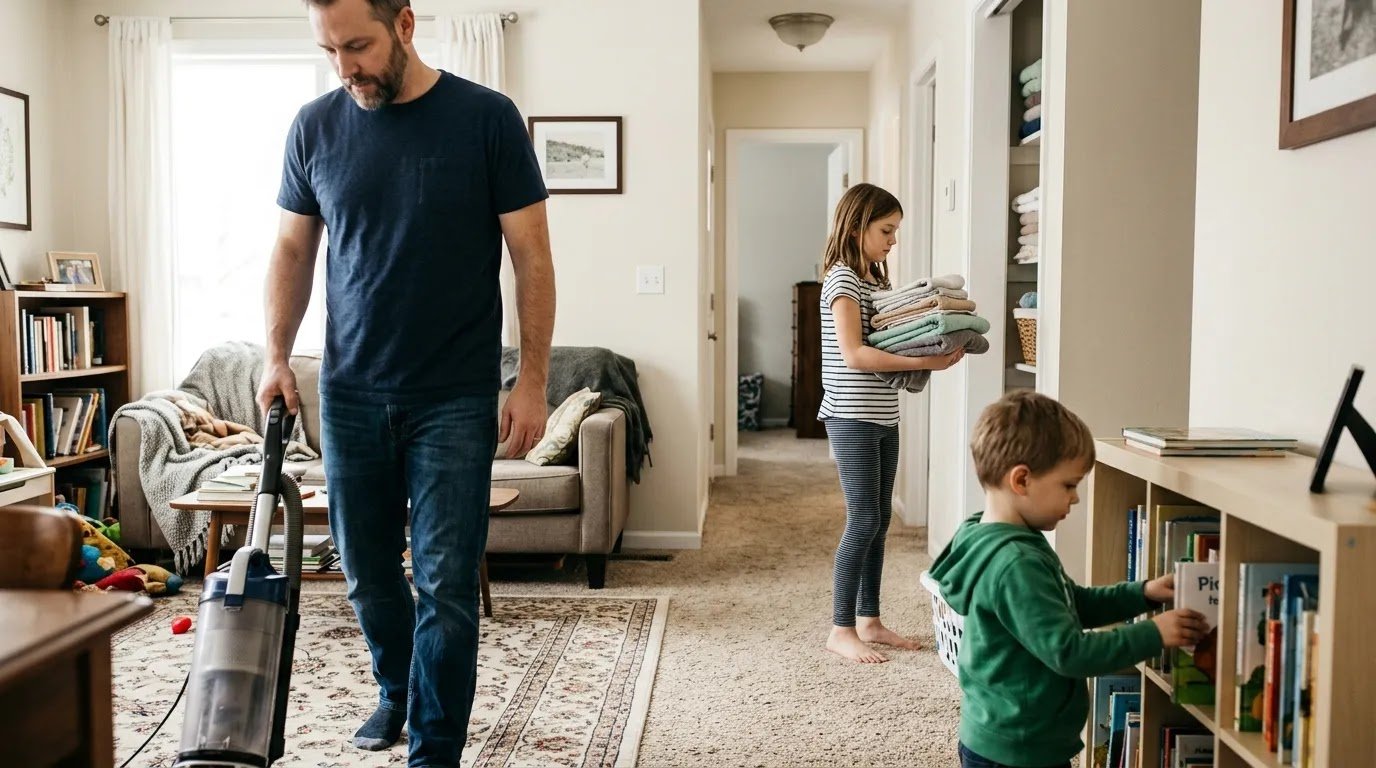
You can rotate by room:
Bathrooms one day, bedrooms another, shared spaces another.
Or rotate by job:
Vacuuming, sheets, bathrooms, dusting.
Both can work.
You usually do not need both.
The purpose of a cleaning routine is to remove decisions—not create an elaborate management system for cleaning.
Layer 3: Keep Occasional Jobs Off the Everyday List
The oven needs cleaning.
The windows need attention.
The hall closet is chaotic.
Those may be real jobs.
They are not today’s dishes.
Keep a short separate list for occasional work.
When you have time—or when one of those tasks actually becomes important—choose one.
This stops every unfinished home project from competing mentally with the basic things that keep tonight and tomorrow working.
Give Each Job a Clear Finish Line
“Clean the living room” can mean:
Put the toys away.
Or:
Vacuum, dust, organize books, clean windows, fluff cushions, and move the furniture.
If family members are using different definitions, conflict is predictable.
Define “done.”
For a daily living-room reset:
- Walkways clear.
- Toys back in baskets.
- Dishes returned to the kitchen.
- Couch roughly reset.
Done.
Vacuuming can belong to the weekly rotation.
Clear finish lines are especially useful for children because broad instructions such as “clean your room” may be much less specific to them than adults realize.
Give Kids Real, Age-Appropriate Jobs
Children can contribute without becoming responsible for maintaining the household.
The AAP’s age-appropriate chores guidance recommends starting with manageable household responsibilities and adding more as skills develop.
Younger children might:
- Put toys away.
- Put dirty clothes in a hamper.
- Carry safe items to their usual places.
- Help wipe an appropriate surface with a safe damp cloth.
School-age children might:
- Set or clear the table.
- Sweep.
- Sort laundry.
- Put away their clothes.
- Empty small wastebaskets.
- Help vacuum appropriate spaces.
Older kids and teens may gradually handle:
- Vacuuming shared spaces.
- Changing sheets.
- Loading or unloading the dishwasher.
- Laundry.
- Appropriate bathroom cleaning after they have been taught how.
Expect learning—not professional housekeeping.
If you need age-specific task ideas, the Free Kids Chore Planner by Age can help you choose realistic responsibilities.
Teach the Job Before Expecting Independence
“Clean the sink” sounds obvious if you have cleaned sinks for years.
It may not be obvious to a child doing it for the first time.
When possible, teach unfamiliar chores when nobody is rushing:
Show → Let Them Try → Correct Briefly → Repeat Another Day.
Then step back as the skill becomes familiar.
There will also be nights when guests arrive in twenty minutes and you simply need to finish the kitchen yourself.
Every cleaning session does not have to become a life-skills lesson.
Cleaning and Disinfecting Are Different Jobs
Your everyday family reset does not need to involve disinfecting every surface.
According to the CDC’s home cleaning and disinfecting guidance, routine cleaning with soap or detergent removes dirt and most germs from household surfaces. Disinfection is more relevant when someone is sick or when someone in the household is at increased risk of illness.
For ordinary daily maintenance:
Clean what is dirty.
Use stronger disinfecting steps when the situation actually calls for them and follow the product label.
Keep Disinfectants and Strong Chemicals Out of Kids’ Chores
A child can participate in household cleaning without handling every cleaning product an adult uses.
The U.S. Environmental Protection Agency states that children should not apply disinfectants, including disinfecting wipes.
For household cleaning products:
- Follow product labels.
- Do not mix products unless the label specifically says to do so.
- Keep chemicals in their original labeled containers.
- Store them out of reach of children and pets.
- Give children cleaning tools and tasks appropriate for their age and supervision level.
A child wiping crumbs from the table is very different from a child being handed disinfectant spray.
Make Safe Cleaning Tools Easy to Reach
Friction can quietly kill a routine.
If every cleanup begins with searching the house for the dustpan, laundry basket, or storage bin, it becomes easier to postpone.
When practical, keep simple safe tools near where they are used:
- A hand broom and dustpan.
- Washable cloths.
- A laundry basket.
- Clearly designated toy or clutter baskets.
Adult cleaning products should still be stored safely and securely.
Have a Rescue Version for Bad Days
Some evenings are not normal.
Everyone gets home late.
A child is sick.
Work runs long.
Dinner barely happens.
Your routine needs a minimum version.
Normal reset:
Dishes, counters, shared-space pickup, laundry contained.
Rescue reset:
Put food away, contain the dishes, handle spills, clear the main walking path.
Then stop.
A routine that works only at full power will disappear on difficult weeks.
Missing a Day Does Not Create Cleaning Debt
Tuesday gets busy and nobody vacuums.
You do not automatically need to add Tuesday’s entire job to Wednesday.
Ask:
Does this actually need doing before its next normal turn?
If yes, move it.
If not, let it wait.
Otherwise every missed job creates a larger tomorrow, and eventually the routine collapses under its own catch-up list.
Do Not Turn the Weekend Into a Debt Collection Day
A weekend cleaning block can work well.
A weekend containing every task ignored since Monday usually does not.
Your daily reset and weekly rotation should reduce the need for marathon catch-up cleaning.
If weekends are already crowded with errands, activities, and household work, how to create a weekend routine without overscheduling the family can help protect space around those obligations.
A Simple Routine to Start With
If your current system is mostly “clean when the mess becomes unbearable,” start smaller than you think.
Every day:
- After dinner: dishes and basic kitchen reset.
- Before the evening winds down: short shared-space pickup.
- Personal belongings return to their usual homes.
Monday: bathroom basics.
Tuesday: vacuum main shared areas.
Wednesday: daily reset only.
Thursday: sheets or laundry catch-up.
Friday: daily reset only unless something clearly needs attention.
Weekend: one larger household job if needed.
That is enough to test.
You do not need to build the final version of your cleaning routine on day one.
Review It After Two Weeks
Give the routine enough time to reveal what does not fit.
Then ask:
What keeps getting skipped?
Maybe it does not need to happen that often.
What keeps piling up?
Maybe it belongs in the daily reset.
What keeps causing arguments?
Maybe the job needs a clearer finish line.
What are we doing that barely matters to us?
Maybe it can happen less often—or disappear from the routine.
Good routines are edited.
The Best Cleaning Routine Is Slightly Boring
Eventually, you want:
“Dinner’s done. Let’s reset the kitchen.”
People roughly know what that means.
They handle their pieces.
The kitchen becomes usable again.
Then everyone moves on.
You are maintaining a home—not finishing one.
People will eat after you clean the kitchen.
Children will play after you pick up the room.
Someone will wear the clothes you just washed.
That does not mean the cleaning failed.
It means the house is being lived in.
Protect your clean-enough line, reset the essentials, rotate the bigger jobs, and let everything else wait until it actually deserves a place on the list.