
How to Fix a Chaotic After-School Routine
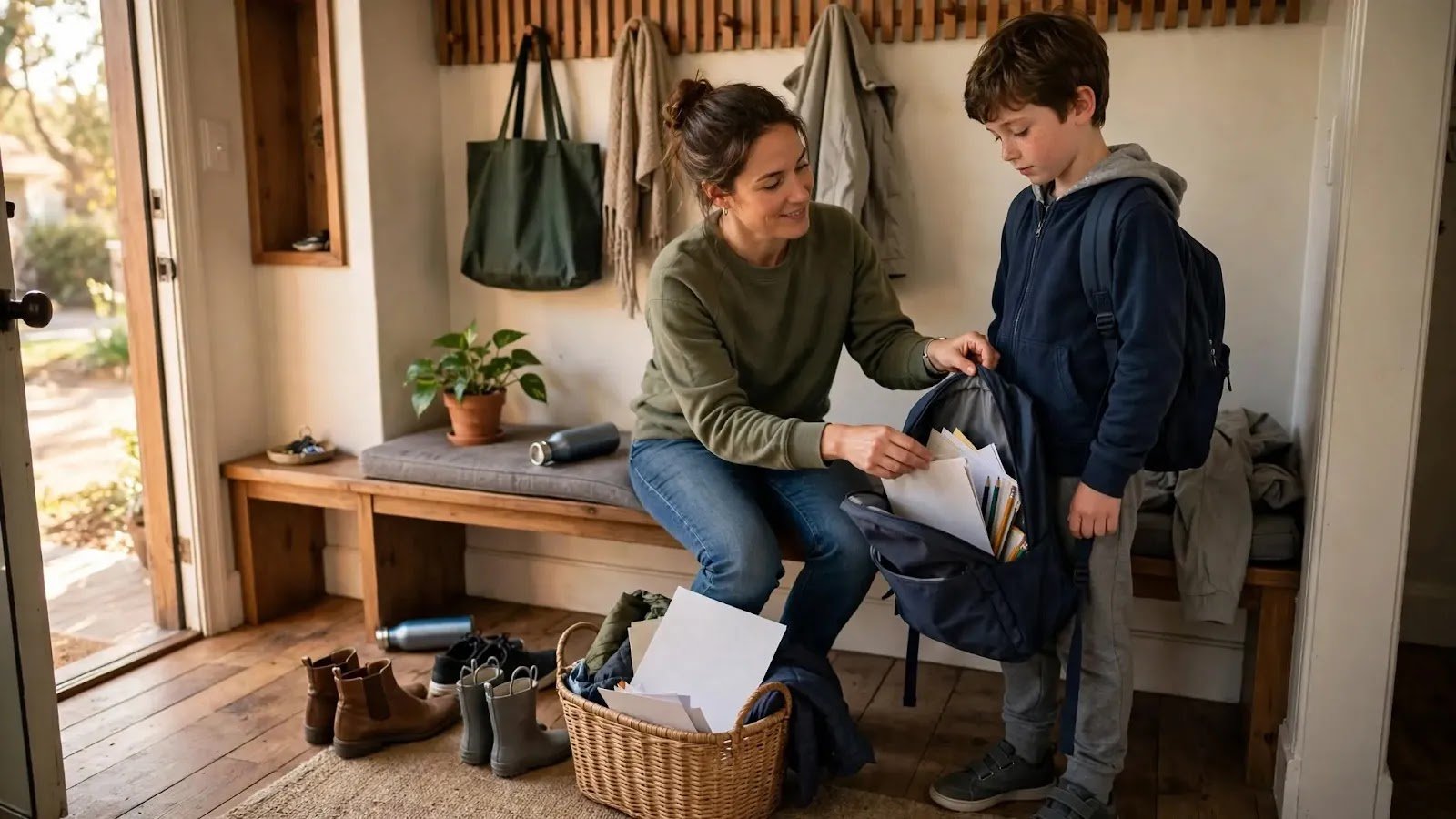
It’s 3:47 p.m.
The backpack is in the hallway. One shoe is under the table. Somebody needs a snack immediately. A permission slip is missing, your child wants a screen, and you are already asking about homework.
The temptation is to build a stricter schedule for the entire afternoon.
Usually, start smaller.
Find the first place the afternoon consistently breaks down and fix that bottleneck before changing everything else.
Find the First Bottleneck
Watch a few ordinary school days before redesigning the routine. Most chaos tends to begin in one of four places:
- Entry: backpacks, shoes, lunchboxes, coats, and papers land everywhere.
- Reset: your child arrives hungry, thirsty, restless, tired, or emotionally drained.
- Sequence: nobody knows whether snack, homework, chores, screens, or play comes next.
- Responsibilities: forms, assignments, activities, and tomorrow’s needs remain scattered until later.
Ask one question:
Where does the afternoon first go off the rails?
If the backpack and school papers are already lost before homework comes up, fix the entry system first. If everything is organized but your child falls apart the moment they walk in, organization may not be the main problem.
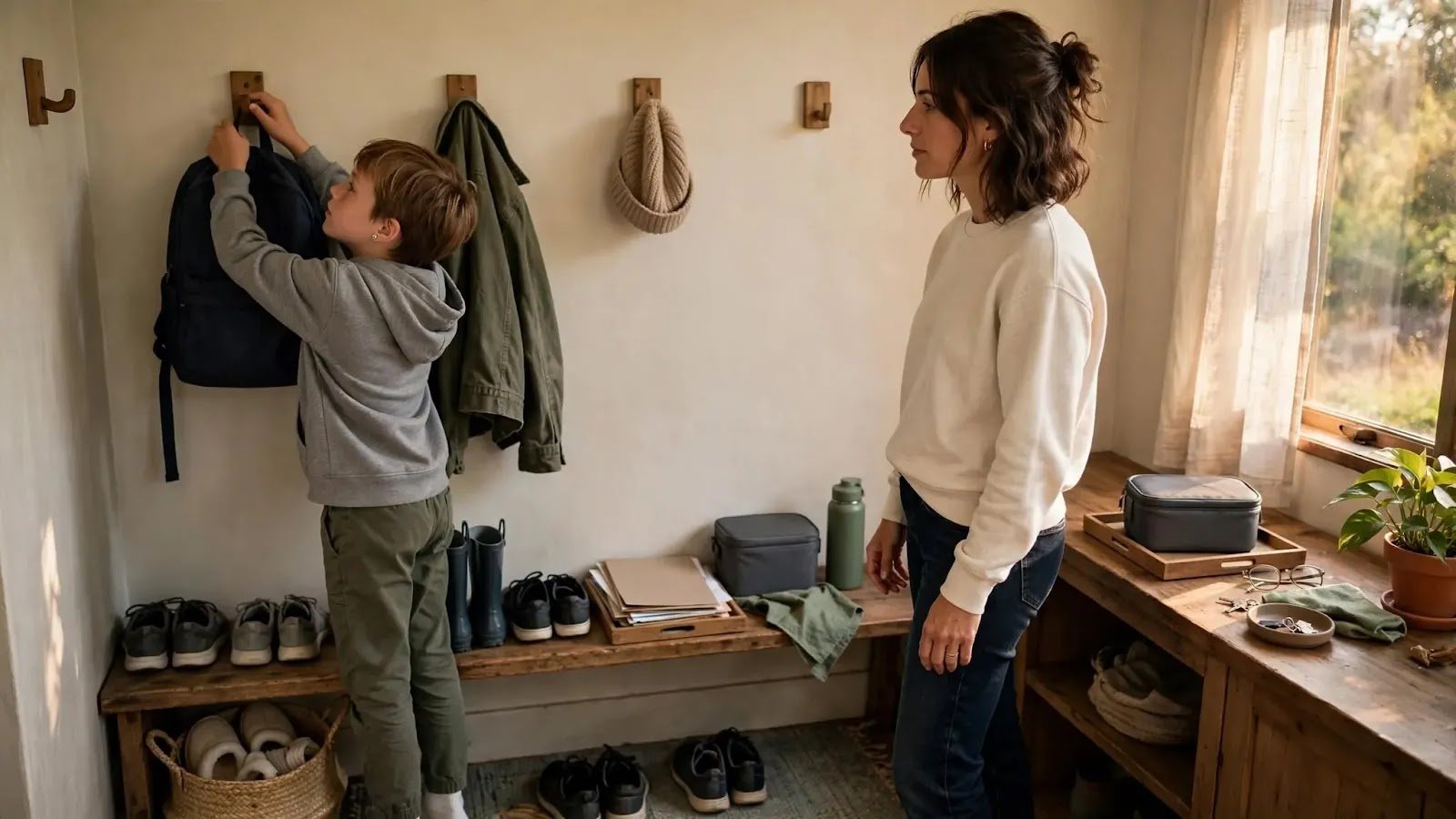
If Entry Is the Problem, Build a Landing Zone
A child carrying a backpack, coat, shoes, lunchbox, water bottle, and school papers needs obvious destinations.
You may only need:
- One backpack hook or spot.
- One place for shoes.
- One destination for the lunchbox or water bottle.
- One tray or basket for papers an adult needs to see.
Then replace “Put everything where it belongs” with a repeatable sequence:
Backpack here. Shoes here. Lunchbox here. Papers here.
The setup should be simple enough for the child who is expected to use it. An elaborate organization system that needs an adult to maintain it will not remove much friction.
If Your Child Is the Bottleneck, Add a Landing Period
Sometimes the bags are not the problem. The child carrying them has simply reached the end of a long school day.
A burst of questions and instructions at the door can make that transition harder:
“How was school? Put your coat away. Do you have homework? Where’s your lunchbox? What happened to your folder?”
Try reducing the first few minutes to what actually needs to happen:
“Put your things away, wash your hands, and come get a snack.”
Then give your child a short reset that fits them: food and water, movement, quiet reading, drawing, a few minutes outside, or a little connection with you.
HealthyChildren.org notes that a healthy after-school routine may include a snack, exercise, relaxation, and study in whatever order works best for the child.
The reset still needs an endpoint. It is a bridge into the afternoon, not an indefinite escape from everything that follows.
If your child regularly comes home unusually irritable or emotional even when the logistics are simple, see why kids sometimes act worse after school and what helps. That article focuses on the emotional transition rather than the routine itself.

If Nobody Knows What Happens Next, Fix the Sequence
An afternoon that gets renegotiated every day creates its own friction.
Monday: “Can I play first?”
Tuesday: “Can I watch something?”
Wednesday: “Do I have to do homework now?”
You do not need an exact minute-by-minute schedule. You do need a basic order.
For example:
Arrive → belongings away → snack/reset → responsibilities → free time.
Or:
Arrive → snack → homework → outdoor time → dinner.
There is no single correct location for homework in every child’s afternoon. Some children work better soon after school, while others benefit from a break first. Once you find the sequence that works reasonably well, keeping its place predictable can reduce repeated negotiation.
If homework itself—not the larger routine—is where everything keeps collapsing, how to build a homework routine without daily nagging focuses on that specific problem.
Use Anchors Instead of Trying to Control the Clock
After-school schedules change constantly. The bus is late. Practice starts earlier. A sibling has an appointment. Homework takes ten minutes one day and forty the next.
Anchors preserve the order without requiring the same clock time:
- After arrival: belongings go to their places.
- After the reset: check today’s responsibilities.
- Before optional screen time: required tasks are handled.
- Before the evening gets busy: urgent items for tomorrow are identified.
The CDC’s current guidance on routines emphasizes consistency, predictability, and simple sequences children can understand.
Your child does not need every afternoon to look identical. They benefit from knowing what usually comes next.
Create One Short Daily Check-In
A lot of evening chaos starts with scattered information:
The permission slip is under the lunchbox. The practice reminder is on your phone. The spelling list is inside the backpack. Your child thinks there is no homework.
After the arrival reset, create one brief check-in:
- Look at the school planner or assignment system.
- Move papers requiring an adult into one place.
- Check whether something must return tomorrow.
- Confirm any activity that changes today’s plan.
Then ask:
“Is there anything you need from an adult before tomorrow?”
That question can catch a signature, supply, uniform, or transportation issue before it becomes a 9 p.m. emergency.
Group Responsibilities Instead of Interrupting Constantly
Repeated instructions scattered across the afternoon can make a workable routine feel chaotic.
Your child starts homework.
“Feed the dog.”
They sit back down.
“Take your shoes upstairs.”
Five minutes later:
“Unload the dishwasher.”
When practical, give routine household jobs a predictable place:
Snack/reset → homework/check-in → household responsibilities → free time.
The exact order can differ. The useful part is that a new instruction does not appear every five minutes.
Move Repeated Reminders Into the Environment
If you say the same four things every afternoon, your voice does not have to remain the family’s only reminder system.
A short visible sequence might be:
- Backpack away.
- Lunchbox to the kitchen.
- Snack and reset.
- Check today’s responsibilities.
The Free Family Routine Builder can help you turn your own sequence into a simple routine that fits your household.
The point is not creating a perfect chart. It is reaching the point where fewer people need to ask, “What am I supposed to do now?”
Do Not Put Every Good Habit Into One Afternoon
This is an easy way to accidentally create the chaos you are trying to remove.
Snack. Talk about school. Exercise. Homework. Reading. Piano. Chores. Bedroom cleanup. Tomorrow’s clothes. Family connection. Screen limits.
Every one of those things may be reasonable.
They do not all need to happen immediately after school.
Decide which tasks truly belong in this part of the day and move the others somewhere more realistic.
A routine that covers fewer things consistently is usually more useful than an ideal routine that repeatedly collapses.
Keep a Core Routine for Different Kinds of Days
Soccer Tuesday will not look exactly like a quiet Thursday afternoon.
Instead of creating five unrelated routines, keep a small core:
Arrive → belongings away → reset → check today’s plan.
Then branch.
Practice day: change clothes → gather gear → leave.
Home afternoon: homework/responsibilities → free time.
A predictable routine is not a rigid routine. When the day changes, tell your child what changes:
“Today we have the appointment, so homework is moving until after dinner.”
The routine still did its job: everyone knows what is happening.
Have a Minimum Version for Chaotic Days
Some afternoons are simply messy. Instead of abandoning the whole system, keep the few anchors that prevent the evening and next morning from becoming worse.
A minimum version might be:
- Put school belongings in their places.
- Eat or drink if needed.
- Check for anything urgent tomorrow.
- Handle the one essential responsibility.
Everything else can flex.
This is often more useful than trying to force a six-step routine into a day that clearly cannot hold it.
If the Routine Still Gets Fought, Find the Exact Step
Do not assume the entire system has failed.
If snack goes smoothly but homework starts the fight, focus on the homework transition.
If your child never reaches snack because putting belongings away takes fifteen minutes, simplify the landing zone.
If everything works until a screen turns on, the friction point may be ending screen time rather than the whole afternoon.
Repair the step where the pattern breaks instead of adding more reminders everywhere.
Try a Four-Day Repair Instead of a Total Overhaul
If you are not sure where to start:
- Day 1 — Observe: Change nothing. Notice the first point where chaos begins.
- Day 2 — Fix the physical friction: Give backpacks, shoes, lunchboxes, and important papers obvious homes.
- Day 3 — Fix the transition: Decide what happens immediately after arrival and what short reset helps your child.
- Day 4 — Fix the sequence: Put the major parts of the afternoon in a simple, repeatable order.
Then stop adding things and watch what happens for a few days.
If one change solves most of the problem, you do not need a more sophisticated system.
Know When Organization Is Not the Main Problem
A routine can reduce logistical friction. It cannot explain every difficult afternoon.
If your child regularly comes home extremely distressed, unusually withdrawn, physically aggressive, persistently exhausted, or deeply worried about school, look beyond organization.
Likewise, if homework routinely takes much longer than expected or schoolwork appears unusually difficult, consider comparing observations with the teacher and, when appropriate, your child’s pediatrician rather than assuming the child simply needs a stricter schedule.
The goal of an after-school routine is not to control every minute between dismissal and dinner.
It is to remove the repeated friction that makes ordinary afternoons harder than they need to be.
Start with the first bottleneck. Give belongings obvious homes. Give the child a workable landing. Make the sequence predictable. Then leave the parts that are already working alone.