
How to Help a Child Handle Losing Without Melting Down
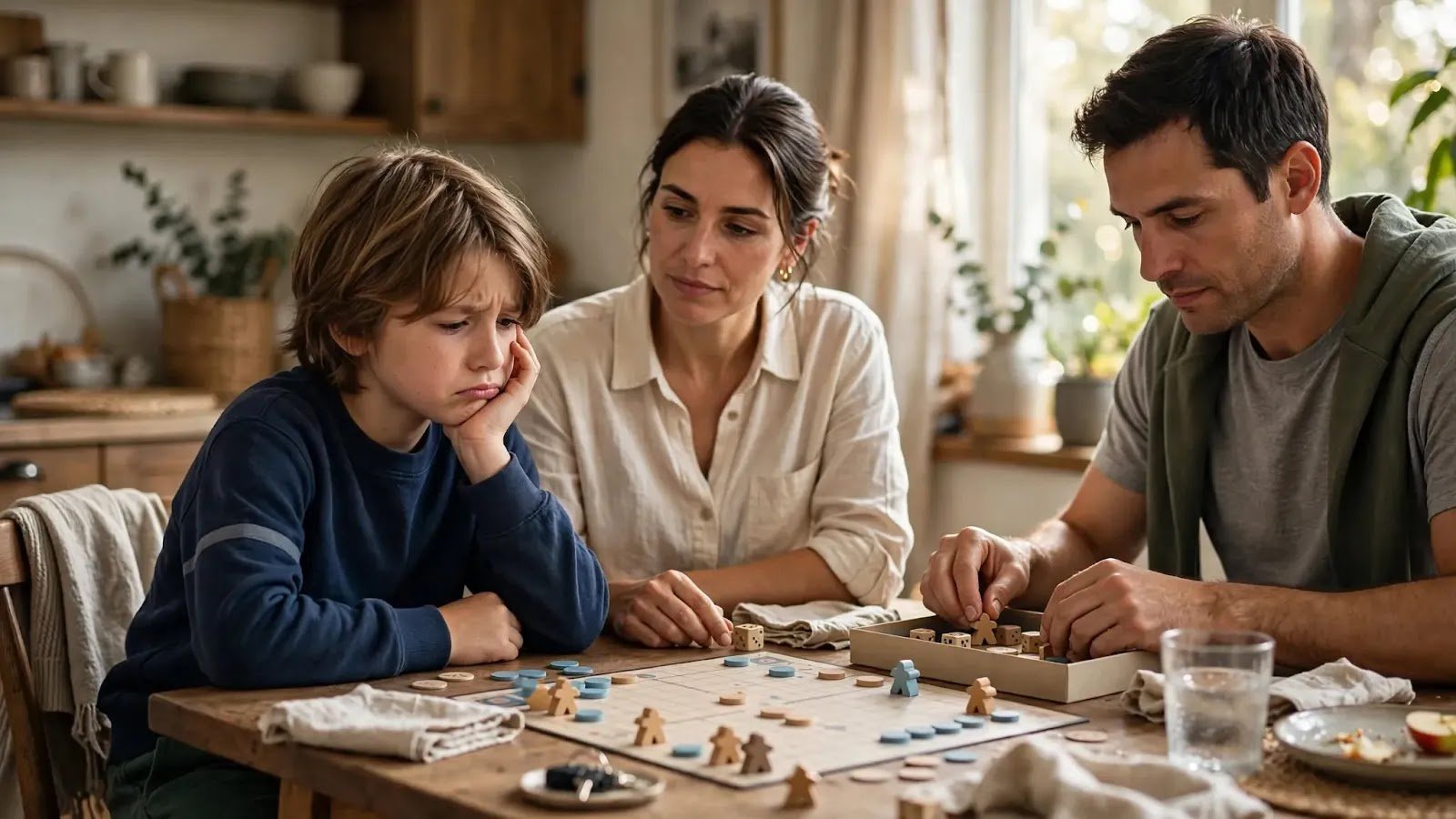
The game ends.
Your child looks at the board.
For two seconds, everything is quiet.
Then the pieces go flying.
“That’s not fair!”
“You cheated!”
“I’m never playing again!”
Your first instinct may be:
“It’s only a game.”
But to a child who badly wanted to win, it does not feel like “only” anything in that moment.
Learning to lose well does not mean learning not to care.
It means being disappointed, angry, or embarrassed without hurting people, destroying things, rewriting the result, or needing everyone else to make the loss disappear.
Teach Losing in Three Different Moments
The easiest way to make this skill manageable is to separate it into three parts:
- Before the game: Set expectations for what winning and losing look like.
- At the loss: Keep words short, protect safety, and let the first wave of disappointment pass.
- After calm: Review one behavior and practice a better response for next time.
Trying to do all three while your child is already furious usually turns coaching into another argument.
Before the Game: Define “Losing Well”
Do not wait until the board is upside down to introduce sportsmanship.
Before a low-stakes game, try:
“One of us will win and one of us will lose. You can be disappointed if you lose. The pieces stay on the table, we don’t insult anyone, and we finish the game safely.”
Then give your child a few realistic phrases:
- “I’m disappointed.”
- “I really wanted to win.”
- “Can I have a minute?”
- “Good game.”
- “I want to play again another time.”
Notice that none requires pretending the loss felt good.
The goal is appropriate behavior, not fake cheerfulness.
Do Not Teach That Effort Guarantees Winning
“If you try your hardest, you’ll win” sounds encouraging, but competition does not work that way.
Two children can both try hard.
One still loses.
A better message is:
“You can’t control whether you win every time. You can control your preparation, effort, choices, and what you do afterward.”
The American Academy of Pediatrics recommends emphasizing effort, sportsmanship, hard work, and skill development rather than criticizing young athletes for losing.
That applies at the soccer field and the kitchen table.
At the Loss: Talk Less
The score becomes final.
Your child realizes they lost.
This is usually not the moment for:
“You need to learn that you can’t always win.”
They are already learning that fact very clearly.
Try:
“You really wanted that one.”
Or:
“You’re really disappointed.”
Then pause.
If your child is upset but still in control, you may not need to do anything else immediately.
Separate the Feeling From the Behavior
Your child is allowed to hate losing.
They are not allowed to throw the game at somebody.
Those ideas can exist together.
Try:
“You can be angry. The pieces stay on the table.”
Or:
“It’s okay to be disappointed. It’s not okay to call your brother stupid.”
Or:
“You can take space. You may not kick the chair.”
The CDC’s current emotion-coaching guidance makes the same distinction: validate emotions while still setting limits on unsafe or unacceptable behavior.
If objects are being thrown, someone is being hit, or property is being damaged, stop the unsafe behavior first.
Do Not Coach During the Emotional Peak
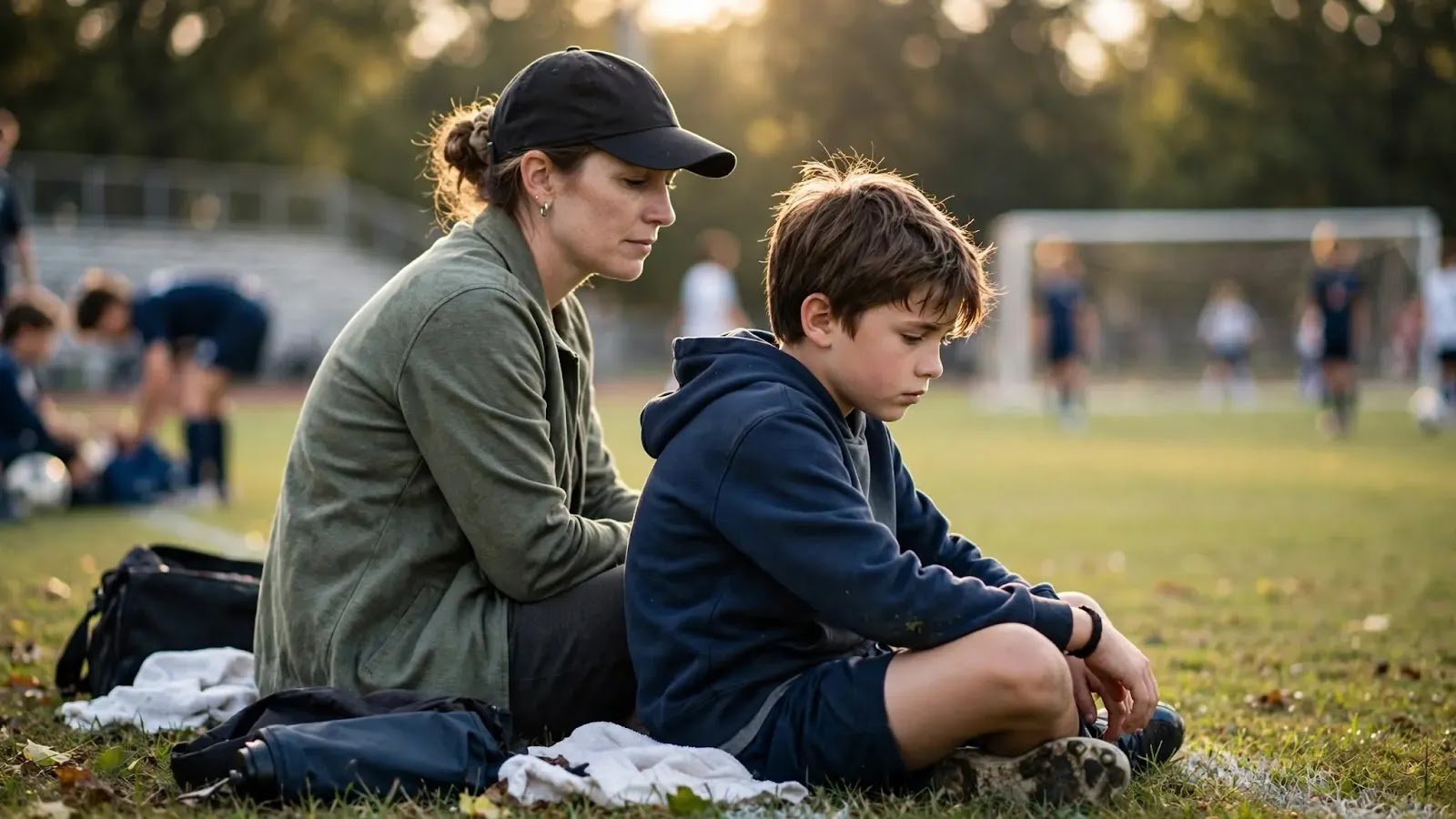
A child walks toward the car after losing an important game.
Their eyes are wet. Shoulders tight.
This is not the ideal opening:
“You know what you should have done in the second half?”
Even useful advice can feel terrible when disappointment is still at full volume.
Try:
“That one really hurt. We don’t have to talk about it yet.”
Then give them some room.
You are not avoiding the lesson.
You are choosing a time when your child can actually use it.
Do Not Force a Sportsmanship Performance Mid-Meltdown
Sportsmanship matters.
But a child who is already sobbing uncontrollably or escalating toward unsafe behavior may not be capable of delivering a calm handshake and cheerful “good game” on command.
If your child still has enough control, prompt briefly:
“Take a breath. Then finish with ‘good game.’”
If they are already overwhelmed, handle the emotional storm first.
Later, practice what they can do next time.
The long-term goal is real self-control—not a forced smile for the adults watching.
Let the Loss Stay a Loss
Some children try to make losing disappear:
“That round didn’t count.”
“You cheated.”
“We have to play again right now.”
If there is a genuine rule dispute, resolve it.
If the outcome is clear, do not spend twenty minutes litigating it.
Try:
“I know you wish that round didn’t count. It does. We can play again another time.”
The experience of being disappointed and surviving the disappointment is part of the skill.
Be Careful With Instant Rematches
A rematch can be fun.
But if every loss immediately becomes:
“Again! Again! Again!”
until your child finally wins, they may learn that a game is not really finished until they get the outcome they want.
Sometimes say:
“We’re done for now. We can play again tomorrow.”
Your child learns something important:
The disappointment can pass even when the result does not change.
After Calm: Get Curious First
Later, instead of opening with:
“Do you understand why your behavior was unacceptable?”
ask:
“What was the hardest part about losing?”
The answer may surprise you.
“Everyone was watching.”
“My brother laughed.”
“I thought I was finally going to beat Dad.”
“I practiced all week.”
Now you know what your child was actually trying to manage.
If your instinct is to immediately fix every feeling they describe, how to listen to your child without immediately fixing the problem can help with this part.
Review One Behavior, Not Their Personality
Avoid:
“You’re such a sore loser.”
“You always do this.”
“Nobody will want to play with you.”
Choose the specific action:
“You were disappointed, then you knocked the board over. What could you do instead next time?”
That gives you something trainable.
“Sore loser” gives the child an identity.
Build a Simple Loss Plan
Ask your child what they can do during the first few seconds after realizing they lost.
A plan might be:
- Keep hands off the pieces.
- Take one slow breath.
- Say, “I’m disappointed.”
- Say “good game” when able.
- Take a short break if needed.
An older child may prefer:
“I’m going to stay quiet for a minute because I say things I regret when I’m angry.”
That can be a useful plan too.
The important part is deciding what to do before the next loss arrives.
Practice Losing When the Stakes Are Small
Championship day should not be your child’s only practice.
Family games offer low-stakes opportunities to experience winning and losing.
Choose games that are reasonably age appropriate and short enough that one outcome does not feel enormous.
Before playing:
“We’re practicing how we act when we win and when we lose.”
Then let the result stand.
If your child handles the loss better than usual, notice the exact behavior:
“You were disappointed, but you kept the pieces on the table and finished the game.”
That is clearer than:
“Good job losing.”
Use Fair Games, Not Engineered Outcomes
You do not need to crush a five-year-old at every strategy game just because you can.
Choose an appropriate challenge.
At the same time, secretly letting your child win every game removes chances to practice genuine disappointment.
A useful standard is:
Fair game. Appropriate challenge. Honest result.
For younger children, the AAP recommends developmentally appropriate competition with more emphasis on participation, skill development, and enjoyment than on winning. Its guidance on readiness for sports similarly stresses development over score-focused competition for younger kids.
Let Your Child Watch You Lose
Your response is a live demonstration.
Your child beats you.
You say:
“Ah, I really wanted that one. Good game.”
Or:
“You got me. I’ll try again tomorrow.”
No fake happiness is required.
You are showing that disappointment and connection can exist at the same time.
If adults accuse others of cheating, complain endlessly about rules, or become furious when they lose, children learn that version too.
Coach Winning Too
Losing becomes much harder when winners are allowed to humiliate the loser.
Teach both sides:
Winner: Be excited without making the other person feel small.
Loser: Be disappointed without attacking.
A simple family rule can be:
“You can celebrate winning and dislike losing. Nobody gets to humiliate the other person.”
After Sports, Skip the Immediate Performance Review
Athletic losses can feel bigger because teammates, coaches, spectators, practice, and personal goals are involved.
Instead of opening the car ride with:
“Why didn’t you pass?”
“You should have…”
“What happened in the second half?”
try:
“Do you want to talk about the game now or later?”
If your child says later, let the car simply be a car.
When you do talk, notice things the final score cannot erase:
“You kept working when the team fell behind.”
“I noticed you helped your teammate up.”
“Your passing looked more controlled than last week.”
Specific observations are more useful than either criticism or exaggerated praise.
Repair Still Matters if the Reaction Hurt Someone
Calming your child does not erase accountability.
If they called a sibling names, threw pieces, or damaged something, address the repair after everyone is calmer.
For example:
“You were really upset when you lost. Calling your sister a cheater was still hurtful. What needs to happen now?”
If repair after mistakes is a recurring skill your child needs, how to teach kids to take responsibility for mistakes goes deeper into that process.
Do not make an apology the price of receiving comfort.
Your child can be supported while upset and still be expected to repair behavior afterward.
For Younger Kids, Losing May Become a Full Tantrum
A preschooler may not be able to calmly announce:
“I am experiencing disappointment about this competitive outcome.”
They may simply fall apart.
Once a younger child is deeply overwhelmed, stop teaching sportsmanship for the moment.
Keep people and objects safe, stay nearby as appropriate, and wait until the emotional intensity drops.
If ordinary frustrations frequently escalate into full meltdowns, how to handle toddler tantrums without turning every meltdown into a battle covers that stage separately.
Adjust the Skill to Age
Preschoolers: Keep expectations small.
“Keep the pieces on the table.”
“My turn, then your turn.”
“Say ‘good game,’ then take a break.”
Elementary-age kids: Help them notice the first signal that losing is becoming hard.
“What happens in your body when you realize you’re probably going to lose?”
They might notice a hot face, tight fists, the urge to quit, or the urge to accuse somebody.
That early signal is when the loss plan becomes useful.
Tweens and teens: Give more space and ownership.
Later, ask:
- What happened?
- What part can you control?
- What do you want to work on next?
Greater maturity does not mean never feeling disappointed. It means gradually taking more responsibility for what happens next.
When Losing Seems Bigger Than Ordinary Disappointment
Some children are more competitive or emotionally reactive than others.
One intense board-game reaction does not automatically signal a larger problem.
Look at the broader pattern.
Consider discussing it with your child’s pediatrician or another appropriate professional if reactions to losing are severe or persistent, repeatedly involve aggression or destruction, cause your child to avoid normal activities or friendships, or occur alongside broader concerns about anxiety, mood, self-esteem, development, or emotional regulation.
The goal is not to diagnose competitiveness.
It is to notice when the reaction is affecting much more than the game.
What Progress Actually Looks Like
Your child loses.
Their face drops.
They say:
“Ugh. I hate losing.”
Maybe they take a minute.
The board stays upright.
Nobody gets insulted.
They do not demand that the score disappear.
That is progress.
The goal is not a child who smiles every time someone else wins.
It is a child who gradually learns:
“I can lose something I cared about, feel awful for a while, and still control what I do next.”