
How to Set Screen-Time Rules Without Daily Arguments

It is 6:27 p.m.
You say:
“Screen time is over. Dinner’s almost ready.”
Your child answers:
“Five more minutes.”
You say no.
“But I’m almost done.”
Another no.
“You always make me stop!”
Now you are arguing about five minutes, yesterday’s five minutes, whether homework counts, what happened at a friend’s house, and why adults get to use phones whenever they want.
The easiest screen-time rule to enforce is usually not the strictest one. It is the one that answers the important questions before the device turns on.
If your family is negotiating the rules every time a child asks for a screen—or every time it is time to stop—the real problem may be that too many decisions are still being made in the heat of the moment.
Move the Screen-Time Decision Earlier
Imagine two versions of the same afternoon.
In the first:
“Can I play?”
“For how long?”
“Can I have more?”
“What if I finish homework?”
“Does watching with my brother count?”
“Can I play until dinner?”
Every request opens a negotiation.
In the second:
“On school days, recreational screens happen after homework and the basic after-school jobs are done. They end when we start getting ready for dinner.”
The child may still dislike the rule.
But nobody has to invent today’s rule at 4:12 p.m.
That distinction matters because current American Academy of Pediatrics guidance does not treat healthy digital life as one universal daily number. The AAP’s 2026 policy emphasizes children’s age and needs, media design, content, family context, and whether digital use is crowding out sleep, movement, learning, relationships, and other healthy activities. HealthyChildren.org’s explanation of the updated AAP media guidance recommends creating screen-free times and spaces while considering how media fits into the child’s broader life.
Your household rule does not need to copy somebody else’s exact number.
It does need to be understandable.
Start With the Problem You Actually Want the Rule to Solve
“Less screen time” is not always specific enough.
Ask what is going wrong now.
Is gaming delaying bedtime?
Are videos stretching through dinner?
Does your child immediately reach for a tablet before homework?
Are weekend screens expanding until nothing else happens?
Does every transition away from a device become an argument?
Your rule should target that problem.
For example:
Problem: bedtime keeps getting pushed later.
Useful rule: recreational devices stay out of bedrooms during the bedtime routine.
Problem: homework is repeatedly postponed.
Useful rule: recreational gaming starts after the agreed homework step is complete.
Problem: dinner begins with ten minutes of arguing over phones.
Useful rule: everyone puts personal devices away before sitting down to eat.
A rule that solves a visible household problem is easier to explain than a vague announcement that the family simply needs “less technology.”
Separate Required Screen Use From Recreational Screen Use
One source of unnecessary arguments is treating every minute with a screen as though it serves the same purpose.
A child may use a laptop for homework.
Then video-call a grandparent.
Then watch short videos for entertainment.
Those are different activities even though all involve screens.
The AAP’s updated policy describes digital media as a broad ecosystem rather than something that can always be understood through time alone.
For household rules, it can help to say exactly what you are limiting:
“This rule is about recreational screen time, not the laptop time your teacher requires for homework.”
That keeps the conversation focused on the behavior you are actually trying to manage.
Make the Starting Rule Predictable
A child should not need to run a daily campaign to discover when screens are allowed.
Choose a starting rule your family can realistically repeat.
It might be based on:
- A time of day.
- A completed routine.
- A specific window.
- A difference between school days and weekends.
For example:
“After snack, homework, and your backpack reset, you can use your gaming time.”
Or:
“Weekend recreational screens start after breakfast, getting dressed, and the morning household jobs.”
Be careful about creating an enormous entrance fee for every screen session.
If the child must complete twelve unrelated tasks before they can touch a device, the screen may become the center of the entire routine anyway.
Keep the prerequisite meaningful and manageable.
Make the Ending Rule as Clear as the Starting Rule
Many screen-time arguments are not really about whether screens are allowed.
They are about the handoff.
Your child knows when gaming starts.
Nobody has agreed on exactly what ending means.
Does “screens off at 6:00” mean:
Stop immediately at 6:00?
Do not start another video after 6:00?
Finish the current game?
Save and exit when a timer rings?
If you and your child are using different definitions, expect conflict.
Create the stopping rule before play begins.
For a simple video or app, that may be:
“When the timer ends, the device gets put away.”
For a game organized into rounds or matches, a reasonable household rule might be:
“When the warning goes off, do not start another match. Finish the current one within our agreed buffer, then stop.”
The exact rule is yours.
The important part is removing the surprise.
Use Warnings Only if They Actually Help Your Child
Some children transition better with:
“Ten minutes left.”
Then:
“Two minutes.”
Others turn every warning into another negotiation.
HealthyChildren.org’s AAP guidance on screen-time meltdowns suggests that device timers or child-set timers can help some families make stopping points more predictable.
You can test what works.
If warnings help:
“Ten minutes left. Don’t start another round after this one.”
If they do not:
Use the agreed ending cue and keep the conversation short.
A warning should prepare the transition.
It should not reopen the original decision.
Create an Exception Rule Before You Need an Exception
A screen rule becomes exhausting when every unusual day forces you to choose between rigidity and surrender.
Grandparents visit.
There is a long flight.
A child is sick.
Friends come over for a gaming afternoon.
The family watches a movie together.
These moments do not necessarily mean the rule failed.
They mean family life has exceptions.
Decide what exceptions mean:
“Movie nights are separate from your usual individual gaming time.”
Or:
“Travel days can have different screen rules. That does not change the school-day rule when we get home.”
The phrase that helps is:
“This is an exception, not a new rule.”
That prevents one unusual Saturday from becoming evidence in Monday’s negotiation.
Do Not Bargain Against Your Own Rule
Your child asks for another fifteen minutes.
You say no.
They keep asking.
You eventually say:
“Fine. Ten.”
From the child’s perspective, the lesson may be:
The first answer is the beginning of negotiations.
You can acknowledge disappointment without changing the decision:
“I know you want more time. We’re still finished for today.”
If you sometimes genuinely decide extra time makes sense, own it clearly:
“I’m making an exception tonight because we’re waiting for Dad to get home. This doesn’t change the usual stopping time.”
Consistency does not mean never changing your mind.
It means making the change deliberately instead of being worn down into it.
Do Not Turn Every Misbehavior Into Lost Screen Time
Your child leaves shoes in the hallway.
No gaming.
They argue with a sibling.
No tablet.
They forget a water bottle.
No video tomorrow.
If screen access becomes the punishment for every unrelated mistake, the device gains even more emotional power in family life.
Use screen-related consequences primarily when they make sense for the screen-related behavior.
For example:
“You continued playing after the agreed stopping point, so tomorrow we’re shortening the session while we practice ending on time.”
Keep the explanation short and connected to the rule.
If you need help doing that without turning the consequence into another argument, see how to explain consequences without lecturing.
Have a Plan for the Five Minutes After the Screen Ends
Parents often design the stopping rule and forget the landing.
The device turns off.
Now what?
If the answer is:
“I don’t know. Go do something.”
the child has just moved from a highly engaging activity into an empty space.
You do not need to entertain them.
But predictable transitions can help.
After-screen options might naturally include:
- Dinner.
- Shower or bath.
- Going outside.
- A snack.
- A familiar household task.
- Reading.
- Music.
- Building or drawing.
- Getting ready for the next family activity.
The best transition is often something that was going to happen anyway.
“Gaming ends when it’s time to take the dog out.”
is easier to understand than:
“Gaming ends, and then you need to mysteriously generate another activity.”
Reduce the Features That Keep Restarting the Decision
Some digital experiences are deliberately built to keep the next piece of content arriving.
The AAP’s updated Family Media Plan guidance recommends considering steps such as turning off autoplay and unnecessary notifications, both of which can make it easier for another video, alert, or interaction to capture attention.
You do not need a complicated technical setup to use the principle:
Make stopping easier than the default design makes it.
Parental controls and device time limits can also support your rule, but they are tools—not replacements for a family agreement.
If the software says the device is finished while the family repeatedly overrides it after an argument, the software is not really the rule.
Make the Rule Apply to Adults Where the Principle Actually Applies
A child hears:
“No phones at dinner.”
Then watches a parent scroll through messages between bites.
You may have a legitimate reason to use a device.
But unexplained double standards make rules much harder to defend.
The AAP Family Media Plan recommends creating expectations for the whole family, including adults.
That does not mean a 9-year-old and a parent need identical access.
It means shared rules should actually be shared.
If dinner is a screen-free family space, adults should usually follow that principle too.
If there is an exception:
“I’m waiting for the hospital to call Grandma back, so I’m keeping my phone beside me tonight.”
Children can understand exceptions better when adults name them honestly.
Let Children Have Input Without Giving Them the Final Vote
Rules work better when children understand the reason and can contribute useful information.
For example, you may not know that:
The game cannot be paused.
The friend group usually plays together at a certain time.
Homework occasionally requires a device after the normal cutoff.
Your child may have a perfectly reasonable suggestion for how a transition works.
Listen.
Then decide.
A school-age child might say:
“Can my warning happen before the match starts instead of in the middle?”
That may improve the rule.
But participation does not mean:
“We only have a rule if everyone votes yes.”
If your child repeatedly treats any family rule as meaningless unless they agree with it, our guide to explaining family rules so kids understand the why goes deeper into that distinction.
Match the Rule to the Child’s Age
Preschoolers
Keep the rule concrete and closely tied to the routine.
For example:
“One show, then we turn the TV off and eat lunch.”
A familiar stopping cue and immediate next activity may work better than an abstract weekly screen budget.
Elementary-Age Kids
This is a useful age for predictable household rules.
They can understand:
what needs to happen first,
when recreational screens are available,
how a timer works,
and which situations count as exceptions.
Give them some voice in the setup while keeping the adult boundary clear.
Tweens and Teens
Older kids increasingly need to practice managing devices rather than simply having devices removed by adults.
Rules can focus more on outcomes and shared boundaries:
“Your phone charges outside the bedroom overnight.”
“Schoolwork, sleep, family responsibilities, and agreed commitments cannot keep getting displaced by gaming.”
“If you’re changing plans because you’re staying online longer, communicate with us.”
As independence grows, involve them more deeply in revising rules—but do not abandon limits that still serve a real family or health need.
When a New Rule Creates More Arguments at First
If your family used to have no predictable limit, introducing one may initially create more resistance rather than less.
That does not automatically mean the rule is wrong.
HealthyChildren.org’s guidance on parental controls and media limits notes that parents should expect some pushback when limits are introduced and emphasizes consistent follow-through alongside positive family communication.
Avoid rewriting the rule during the meltdown.
If your child is highly upset:
“I know you’re angry that screen time ended. We’re not changing the rule right now. We can talk about whether the plan needs adjusting later.”
Later means later.
If the rule truly is unrealistic, fix it when everybody is calm.
You can change a bad rule without teaching that escalation is how rules get changed.
Run a One-Week Screen Rule Test
If your current rules feel messy, do not redesign your family’s entire digital life in one evening.
Choose the argument you are most tired of having.
Then test one clearer rule for seven days.
For example:
Problem: gaming never ends without a fight.
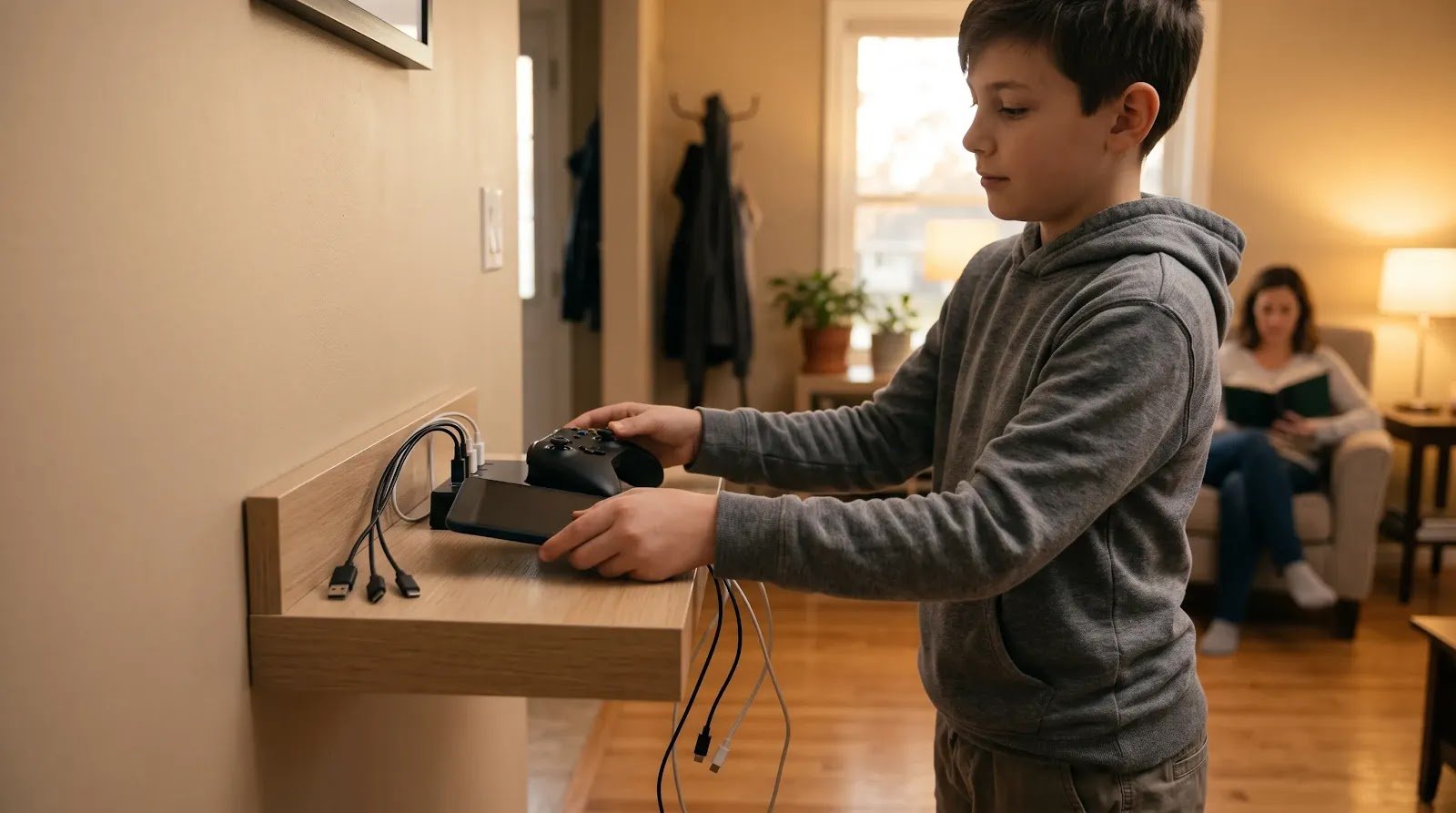
One-week rule: on school days, gaming happens after homework and ends at the dinner transition. A warning means no new match starts. When the current match ends, the controller goes on the charging shelf.
Then watch:
Was the starting point clear?
Was the stopping point realistic?
Did the warning help?
Were exceptions confusing?
Did the adults follow the rule they were asking the child to follow?
Change what does not work.
Keep what does.
The Rule Test: If you have to explain, renegotiate, and redefine the same screen rule every day, make the rule more concrete before making it stricter. A child should be able to tell you when screen time can start, what ends it, and what happens next.
Use a Written Agreement When Too Much Is Living in Your Head
Once a family has several devices, different ages, weekend rules, gaming, phones, and exceptions, verbal rules can become difficult to remember consistently.
You do not need a legal contract.
A short shared agreement can make expectations visible and easier to revisit calmly.
The Free Family Technology Agreement Builder can help you create a family-specific agreement instead of trying to remember every rule during the next argument.
Keep this article’s goal narrow, though:
You do not need to solve every digital-safety, privacy, content, phone, and social-media question before you can fix tonight’s screen-time transition.
Start with the rule that keeps causing the fight.
When the Problem Seems Bigger Than the Rule
Some resistance to stopping an enjoyable activity is normal.
A child complaining about screen limits does not by itself mean there is a serious problem.
Look at the wider pattern.
HealthyChildren.org recommends talking with your child’s pediatrician when media use is consistently interfering with areas such as sleep, exercise, school performance, family participation, eating or hygiene, or when intense meltdowns happen almost every time the child must stop despite thoughtful limits.
Do not diagnose a child from one difficult transition.
But do not keep making increasingly complicated household rules if digital use appears to be significantly disrupting everyday functioning.
The Goal Is to Make Screen Time Less Important to Argue About
A good rule eventually becomes boring.
Your child knows when screens can happen.
They know what ends the session.
They know whether tonight is a normal day or a clearly named exception.
They know what happens if they ignore the agreement.
And they know the adults are not going to hold a fresh debate every time the screen turns on or off.
Your child may still ask for more.
They may still complain.
They may still prefer their version of the rule.
Success is not a household where nobody ever objects to a limit.
It is a household where the answer no longer has to be invented from scratch every day.