
How to Build a Homework Routine Without Daily Nagging
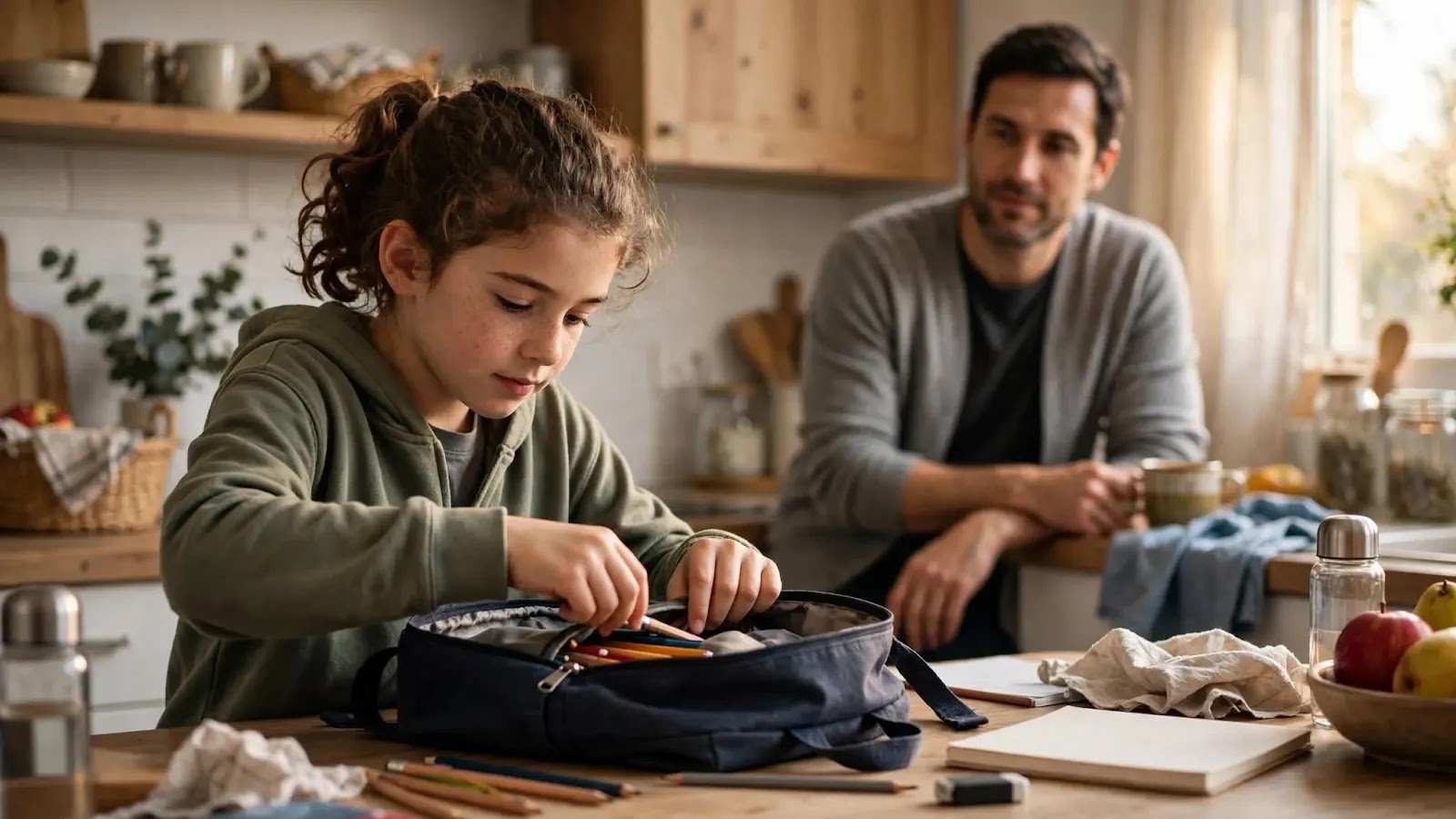
“Did you start your homework?”
“In a minute.”
Ten minutes later:
“Homework.”
“I know.”
Another ten minutes pass. Now your child is annoyed that you keep reminding them, and you are annoyed that apparently nothing happens unless you keep reminding them.
A better homework routine should gradually make you less important to the starting process.
The goal is not “a child who never needs help.” It is a system where the routine—not your voice—answers five questions:
- When do I start?
- Where do I work?
- What do I do first?
- When do I ask for help?
- How do I know I’m finished?
Start With a Cue, Not Another Reminder
Choose one predictable event that means homework begins.
It might be:
After snack.
After 20–30 minutes of downtime.
Before recreational screens.
Or a different sequence on activity days.
HealthyChildren.org recommends making homework part of a regular routine and creating enough scheduled time for it. Its current back-to-school guidance also emphasizes a consistent homework-friendly environment.
Do not choose a time simply because it sounds disciplined. Choose a cue your child can realistically repeat.
If two options work for your family, let your child have some input:
“Would you rather start right after snack or after a 20-minute break?”
Then test that choice for several school days instead of renegotiating every afternoon.
Do Not Start at the Worst Point in the Afternoon
Some children arrive home ready to work.
Others arrive hungry, restless, mentally tired, or needing a little quiet before they can shift into homework.
A short snack, water break, movement period, or quiet reset may make starting easier without turning the afternoon into unlimited downtime.
If your child regularly comes home especially irritable or overwhelmed, why kids sometimes act worse after school and what helps looks at that transition specifically.
This article stays narrower: once you have chosen a workable homework point, how do you make starting require less nagging?
Teach the Homework Launch
Use one sequence until it becomes familiar:
Cue → Check → Choose → Start.
Cue
The agreed homework anchor arrives.
Instead of:
“I’ve already told you twice to start.”
you can initially prompt:
“Snack is finished. What’s next?”
The long-term goal is for your child to know the answer without the question.
Check
Your child checks what actually needs to be done.
Depending on the school, that may mean:
- Opening a planner.
- Checking an assignment folder.
- Looking at the school’s assignment system.
- Taking needed papers from the backpack.
This is more useful than relying entirely on:
“Do you have homework?”
“I don’t know.”
Choose
Ask:
“What are you starting with?”
Some children prefer the easiest task first to build momentum. Others want the hardest part finished first.
Unless the order itself is causing problems, either can work.
Start
“I’m going to do math” is not quite the finish line for the launch.
The first task should actually be open and underway.
This matters for the child who can spend fifteen minutes preparing to start without starting anything.

Make the Workspace Ready Before Homework Starts
Your child finally sits down.
Then:
“Where’s a pencil?”
“I need my charger.”
“There’s no paper.”
Every missing item creates another exit from the task.
A homework space does not need to be a dedicated study room. A kitchen table can work.
What matters is that it is reasonably suitable for working and that commonly needed supplies are easy to find.
HealthyChildren.org recommends a consistent workspace that limits unnecessary distractions and notes that checklists, timers, and parental supervision can help children who need additional organizational support.
A small homework kit might contain:
- Pencils and erasers.
- Paper.
- Basic school supplies.
- A calculator when appropriate.
- A charger if schoolwork requires a device.
The goal is simple:
When homework starts, homework can actually start.
Move Repeated Instructions Into a Checklist
If you say the same sequence every day, let the routine carry some of it.
A short checklist might say:
- Check assignments.
- Choose the first task.
- Complete today’s work.
- Check the assignment list again.
- Pack finished work.
The list should reduce reminders—not become another complicated project your child needs you to explain.
If you want to build the sequence around your family’s actual afternoon, the Free Family Routine Builder can help move those recurring steps out of your head and into a visible routine.
Decide When You Will Help Before the Work Begins
Without a plan, parents can fall into one of two extremes:
Hovering: “Are you working? What are you doing now? Did you finish that?”
or:
Disappearing: leaving a child completely alone with work they genuinely cannot figure out.
Try planned check-ins instead.
For example:
“Start the first task. I’ll check back in ten minutes.”
Or:
“Try the first three problems. Bring me the one you’re stuck on.”
For a more independent child:
“Come find me when you’re finished or after you’ve tried something and still need help.”
As independence grows, stretch the time between check-ins.
Help Without Becoming the Homework Manager
Your job is to provide structure, supplies, reasonable help, and communication with school when necessary.
The assignment still belongs to your child.
If they say:
“I don’t know how to do this.”
try:
“Show me where you got stuck.”
Or:
“What did your teacher show you about this?”
Or:
“Try the first step and I’ll stay nearby.”
The goal is to help your child re-enter the work—not quietly take over the assignment.
Use Timers Only If They Replace Reminders
A timer can make a transition more objective:
“Your break ends when the timer goes off.”
Or it can define a manageable work period:
“Work for fifteen minutes, then take a short movement break.”
But a timer stops helping if the parent narrates every minute:
“Twelve minutes left!”
“Now eight!”
Use tools to remove some of your verbal reminders, not create new ones.
Plan Short Breaks for Longer Work
Some assignments require enough sustained effort that a short break helps.
HealthyChildren.org’s current school guidance suggests occasional stretching or brief breaks when they will not be too disruptive.
A break might mean:
- Getting water.
- Standing and stretching.
- Walking around for a few minutes.
- Doing brief movement.
Keep the endpoint clear.
“Take five minutes.”
works differently from:
“Go relax until you feel like coming back.”
If recreational screens make returning to homework consistently difficult, choose a different kind of break during the work period.
Keep Screens Predictable
A common homework fight begins after gaming is already underway.
Then homework is not simply starting—it is requiring your child to stop something highly preferred first.
Decide ahead of time where recreational screens fit.
For example:
Homework before gaming on school days.
Or:
A defined after-school screen break, then homework when the timer ends.
The exact family rule can vary.
The useful part is removing the daily negotiation about whether homework has to happen now.
Give Homework a Closing Routine Too
The worksheet is finished.
Your child walks away.
The next morning:
“WHERE IS MY HOMEWORK?”
Finishing the questions is not the same as finishing the routine.
Teach:
Check → Pack → Reset.
Check
Your child checks the assignment list to make sure the known work is complete.
The goal is not necessarily for you to correct every answer.
Pack
Finished work goes directly into the correct folder or backpack.
Avoid creating a special pile for “finished homework that may or may not make it to school.”
Reset
Basic supplies go back where they belong so tomorrow’s launch is easier.
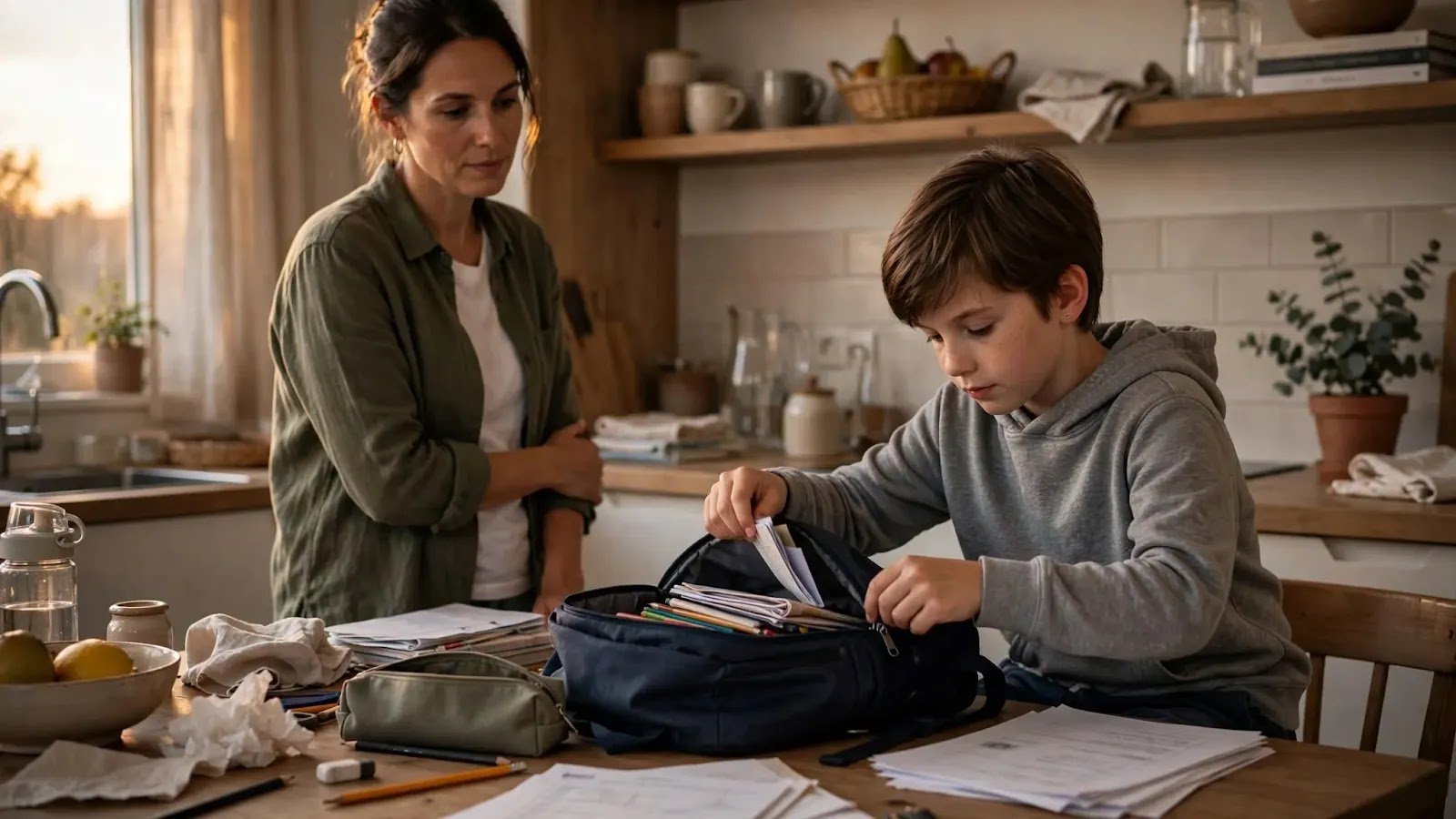
Transfer the Remembering Back to Your Child
Parent:
“Did you do math?”
“What about reading?”
“Are you sure there’s nothing else?”
Those questions may be necessary while teaching the routine.
But eventually replace them with:
“Check your assignment list before you say you’re finished.”
That small change matters.
Your child is no longer relying on the parent to remember every assignment for them.
If Your Child Still Will Not Start, Find the Friction Point
Avoid responding with ten reminders.
Return to the agreed routine:
“Homework starts after snack. Snack is finished. What’s your first step?”
If your child simply does not want to begin:
“I know you don’t feel like starting. Homework still needs to happen before gaming.”
Then keep the family expectation steady.
If refusal keeps happening, investigate the specific point where the routine fails:
- Is the start cue unrealistic?
- Does your child know what was assigned?
- Is the work consistently confusing?
- Is the workspace too distracting?
- Does your child need more help beginning the first task?
- Are activities leaving too little realistic homework time?
A routine can solve friction. It cannot make an assignment understandable when the child genuinely does not understand it.
If the Entire Afternoon Is Chaotic, Fix That Separately
If backpacks disappear, snacks happen randomly, activities shift daily, and nobody knows what comes next, homework may simply be where a larger routine problem becomes visible.
How to fix a chaotic after-school routine focuses on diagnosing those wider bottlenecks.
If you are building the whole afternoon from scratch rather than repairing only homework, see how to create an after-school routine for elementary-age kids.
For this homework routine, stay narrow:
When does it start? Where does it happen? How does the child launch? When do you help? How does it close?
Notice Independence, Not Only Correct Answers
The habits that eventually reduce nagging are easy to overlook.
Notice them:
“You started without a reminder.”
“You checked the planner before saying you were done.”
“You got stuck and asked for help instead of walking away.”
“You packed everything when you finished.”
You do not need to praise every worksheet.
But independence should not become invisible simply because it caused no problem.
Know When to Contact the Teacher
Some homework problems are not routine problems.
HealthyChildren.org recommends speaking with the teacher when a child is struggling with a subject or when there are ongoing concerns about assignments.
Consider checking in when:
- Your child regularly does not understand what assignments are asking.
- Everyday homework requires substantial adult teaching.
- Work consistently takes far longer than expected.
- Your child repeatedly cannot complete material they were expected to understand from class.
- You are unclear about how much parents should review or correct.
The goal is to make sure home and school are working from the same picture—not to solve a schoolwork problem by adding more nagging at home.
Try a Five-Day Homework Reset
If your current routine mostly consists of reminders, rebuild one piece at a time.
Day 1 — Choose the cue.
Decide when homework normally begins.
Day 2 — Fix the setup.
Choose the workspace and put common supplies there.
Day 3 — Teach the launch.
Practice Cue → Check → Choose → Start.
Day 4 — Plan your help.
Decide when you will check in and when your child should ask for assistance.
Day 5 — Teach the close.
Practice Check → Pack → Reset.
Then notice which sentence you are still repeating most often.
That repeated sentence points to the next part of the system that needs improvement.
If repeated reminders are a wider pattern throughout your day—not only homework—how to stop repeating yourself to your kids all day addresses that problem directly.
A homework routine without daily nagging does not mean your child suddenly loves homework or never needs support.
It means fewer parts of the process depend on you remembering, prompting, hovering, and repeating.
Teach the launch. Plan the help. Teach the close. Then gradually step back from the parts your child can manage.