
Why Kids Act Worse After School and What Helps

The teacher says your child had a great day. Ten minutes later, the backpack hits the floor, the wrong snack is suddenly a disaster, and asking them to hang up a jacket starts an argument.
That contrast can feel baffling, but it does not automatically mean your child is deliberately saving their worst behavior for home. School can require hours of attention, transitions, social problem-solving, following directions, tolerating frustration, and keeping emotions contained. By late afternoon, hunger, fatigue, homework, or one difficult interaction may leave very little flexibility.
So before treating the first meltdown as a discipline problem, look at the transition. A calmer landing after school will not remove every boundary or solve every difficult day—but it can show you whether your child needs less pressure before they can handle more.
Why After School Can Be the Hardest Part of the Day
You may hear the informal phrase “after-school restraint collapse” used for children who seem to hold themselves together at school and unravel afterward. It is a description of a pattern, not a diagnosis.
And that pattern does not look the same in every child.
One child gets argumentative. Another cries over something that would normally be minor. Another becomes loud and physically restless. Some retreat to their room and want silence. Others seem completely fine until the first request is made.
HealthyChildren.org from the American Academy of Pediatrics explains that children who feel overwhelmed or stressed may communicate what they are experiencing through behavior before they have the skills or words to explain it clearly.
Instead of asking only, “How do I stop this behavior?” it can help to ask, “What is making this particular part of the day difficult?”
Possible contributors include a demanding school day, friendship problems, constant transitions, noise, hunger, thirst, too little sleep, a long trip home, or another round of work and activities waiting immediately after school.
Build a Landing, Not Another Shift
The first few minutes after school do not have to be maximally productive.
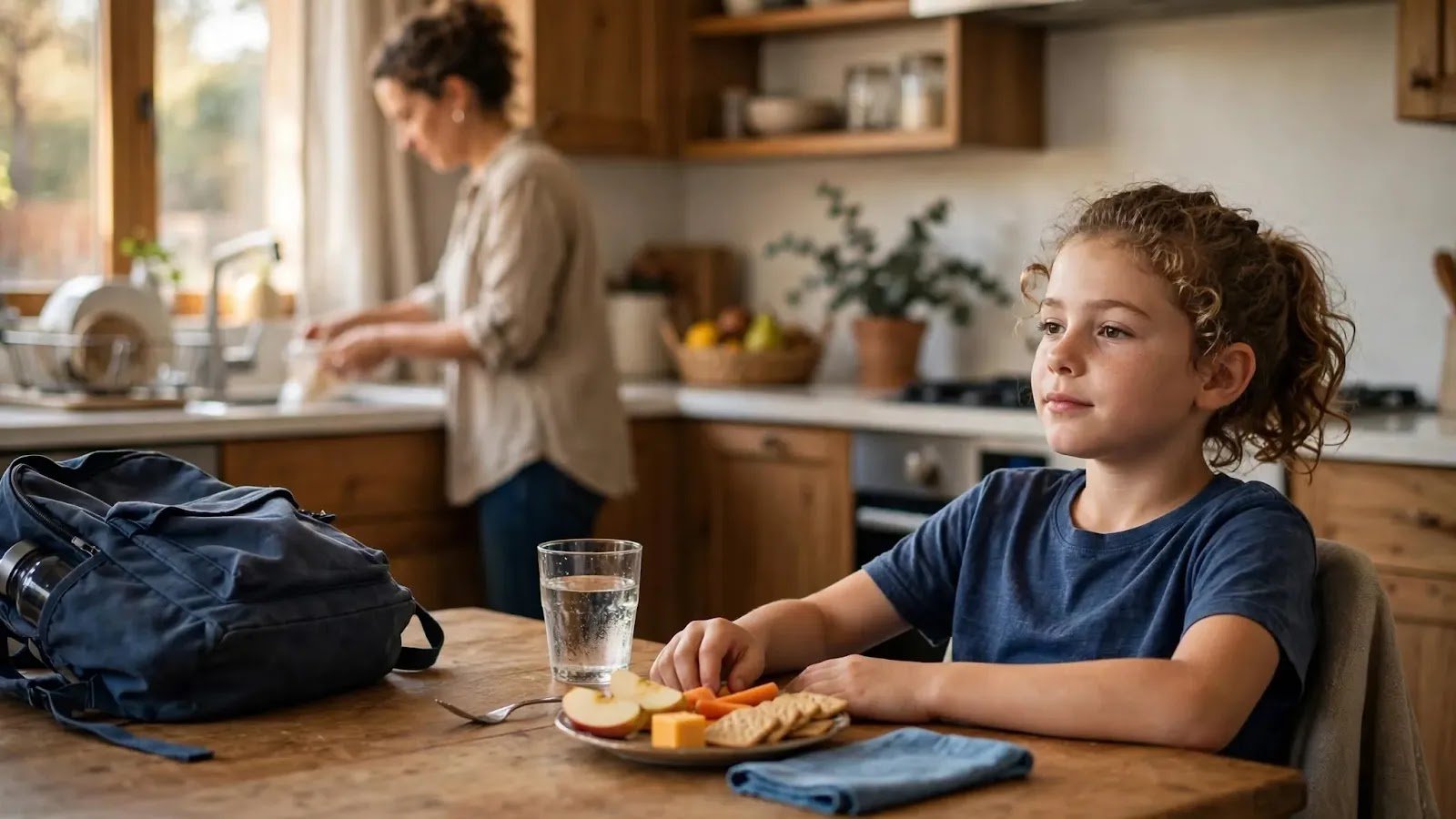
A simple landing routine can give your child a predictable bridge between school and home:
- Put school belongings in their usual place.
- Have water and a snack if needed.
- Take a short period with relatively few demands.
- Use movement, quiet, play, or connection to reset.
- Move into homework, chores, or evening responsibilities afterward.
Different children may need very different versions of step four.
A child who has been sitting and concentrating may want to run outside, ride a bike, shoot baskets, dance, or simply move around. Another may need quiet reading, drawing, music, building, or a little time alone. A third may want ten minutes beside you at the kitchen counter talking about anything except school.
Watch the result. The best decompression activity is not the one that looks most relaxing to an adult. It is the one that tends to leave your child more able to handle what comes next.
If the whole afternoon currently feels improvised, the more detailed guide to fixing a chaotic after-school routine can help you organize the larger schedule.
You can also use the Free Family Routine Builder to turn the steps that work for your child into a predictable sequence instead of repeating them from scratch every afternoon.
Check the Ordinary Things First
Before analyzing every sharp response, check whether your child is hungry, thirsty, or exhausted.
That does not mean a snack explains every meltdown. It means a child who has gone through a long school day may have less capacity for homework, chores, sibling conflict, and a detailed conversation before basic needs are met.
Sleep deserves attention when the pattern is frequent. HealthyChildren.org notes in its guidance on sleep and health that inadequate or poor-quality sleep can be associated with irritability, reduced patience, behavior difficulties, and greater difficulty regulating emotions.
If afternoons reliably become harder after late nights or early mornings, part of the solution may begin before bedtime. A consistent bedtime routine kids can actually follow may help if sleep is one of the recurring weak points.
Look for a pattern rather than assuming every difficult afternoon has the same cause.
Do Not Put the Entire Evening at the Front Door
There is a particular kind of after-school pileup that can make almost any tired child bristle:
“Hang up your jacket. Empty your backpack. How was school? Why didn’t you eat your lunch? Start your homework. Pick up those shoes. And what happened on your math test?”
The individual requests may all be reasonable. The timing is the problem.
Keep the few arrival tasks that genuinely need to happen—perhaps shoes away and backpack on its hook—but consider delaying everything that does not need an immediate answer.
The same applies to conversation.
“How was school?” followed by five follow-up questions can feel like another assignment to a child who has just finished the school day. A warm “I’m glad to see you” may be enough at pickup.
Later, try something easier to answer:
- “What was the easiest part of today?”
- “Was recess fun or frustrating?”
- “Did anything surprise you today?”
- “Do you want to talk about school now or later?”
If “Fine” and “Nothing” are the only answers you usually get, getting kids to talk about their day without relying on “How was school?” goes deeper into that specific problem.
Choose a Homework Time That Actually Works
Homework does not have to begin the minute your child gets home.
The American Academy of Pediatrics notes in its homework guidance that there is no universally right time: some children work well soon after school, while others benefit from unwinding first.
The useful question is not “Which schedule sounds most disciplined?” It is “Which schedule lets this child get the work done reasonably consistently without turning every afternoon into a fight?”
You might test:
Home → snack → short break → homework
or:
Home → snack → homework → free time
Once you find a workable pattern, consistency usually matters more than repeatedly renegotiating it. If homework itself has become the daily conflict, see how to build a homework routine without daily nagging.
What About Screens Right After School?
For some kids, a little screen time feels like an easy mental break. For others, the device creates a second difficult transition when it is time to stop.
Instead of assuming screens are either the perfect decompression tool or automatically the problem, watch what happens afterward.
Can your child stop at the agreed time and move into homework, dinner, or another part of the evening? Or does the end of screen time reliably trigger the next major fight?
If screens make the transition harder, test another type of downtime. If they fit your household without crowding out sleep, homework, movement, meals, or family responsibilities, the question becomes how they fit into the routine—not whether every child needs the same rule.
Decompression Does Not Cancel Boundaries
Understanding a child’s overload is not the same as accepting unsafe or cruel behavior.
You can acknowledge both realities at once:
“You look exhausted and really angry. You can have some space. You cannot hit your brother.”
When emotions are high, safety comes first and fewer words usually help. The explanation, problem-solving, or consequence can wait until everyone is able to participate in the conversation.
Being curious about what triggered an outburst does not require pretending the outburst was acceptable.
Investigate the Pattern After Everyone Is Calm
The peak of an after-school meltdown is rarely the best time to find out what happened during math, lunch, or recess.
Come back later:
“I’ve noticed afternoons have been really hard this week. What part of coming home feels toughest?”
Or compare two days:
“Yesterday seemed easier than today. Was anything different?”
For a week or two, notice a few useful clues:
- How your child slept.
- Whether they ate during the school day.
- Whether behavior shifts after a snack or break.
- Which days or activities seem hardest.
- When homework begins.
- Whether the same school subject, classmate, or event keeps coming up.
- How long your child usually needs before settling.
This is not about tracking every mood. You are looking for repeatable clues that make the afternoon easier to understand.

When School and Home Seem to Be Seeing Different Children
If a teacher describes a calm, cooperative child while home life becomes intensely difficult every afternoon, neither picture necessarily cancels out the other.
Compare notes using specific questions:
- Does my child seem tired or less flexible late in the day?
- Are transitions particularly difficult?
- Have you noticed friendship problems?
- Are certain assignments unusually frustrating?
- Does my child avoid asking for help?
- Has anything changed recently?
You may learn that school is going smoothly and the difficulty really is concentrated around the transition home. Or you may uncover a pattern involving learning, friendships, anxiety about a particular part of the day, or another issue that was not obvious from a general “Everything is fine” update.
When to Look Beyond an Ordinary After-School Slump
Tired, irritable afternoons happen. Pay closer attention when the behavior is frequent, intense, worsening, suddenly different, or affecting everyday functioning beyond the transition home.
Consider talking with your child’s pediatrician and, when appropriate, school staff if you notice:
- Very intense outbursts on most school days.
- A sudden major change in behavior.
- Aggression that is difficult to keep safe.
- School refusal or strong fear about attending school.
- Persistent headaches, stomachaches, or other complaints associated with school days.
- Major changes in sleep or appetite.
- Ongoing sadness, withdrawal, or irritability outside the after-school period.
- Academic or social difficulties that are getting worse.
Those signs do not point to one diagnosis. They are reasons to gather more context instead of assuming the issue is simply “bad behavior after school.”
Try Changing Only the First 30 Minutes
You do not have to redesign the entire evening this week.
For the next few school days, experiment with the arrival window:
- Welcome your child without immediately reviewing grades, homework, or behavior.
- Offer water and a reasonable snack if needed.
- Use a predictable decompression option.
- Keep immediate demands to what truly needs to happen.
- Begin homework or chores at the time your family has chosen.
- Discuss problems later, once everyone is calmer.
Then ask one useful question:
Did changing the transition change what happened next?
If it did, you have found a lever worth keeping. If it did not, that is useful information too. You can look more closely at sleep, school stress, homework, friendships, activities, or another recurring pressure.
A child who falls apart after school is not necessarily showing you who they “really” are. Sometimes home is simply where the strain of the day finally becomes visible.
Keep the safety limits. Keep the necessary responsibilities. But give the transition enough breathing room that you can tell the difference between a child who needs a boundary and a child who needs ten minutes, a snack, and a chance to come home first.