
Free Printable Age-Appropriate Chore Chart for Kids
A chore chart is only useful if your child can tell what to do next—and you aren’t left interpreting every empty checkbox. This free printable age-appropriate chore chart for kids gives you a simple starting point, whether your child is helping put away toys or learning to manage a weekly household responsibility.
The three-page PDF includes 15 chore suggestions for ages 2–17, a ready-to-use weekly chart, and a blank version. You can print just the pages you need and begin with one or two manageable jobs.
Download the Free Age-Appropriate Chore Chart for Kids (3-Page PDF)
Print on US Letter paper (8.5 × 11 inches) at 100% scale. There is no need to complete every row or use the chart seven days a week.
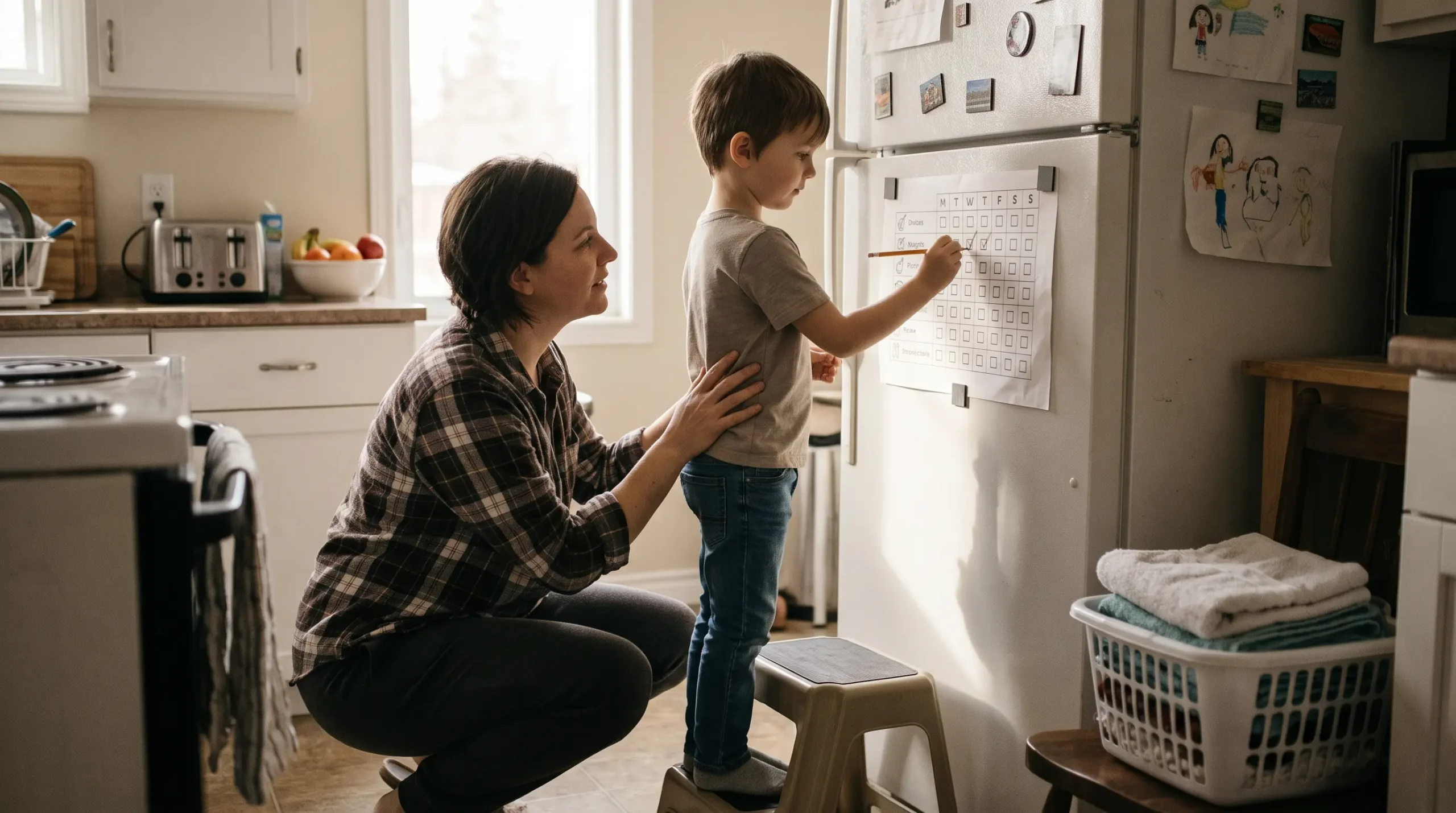
Which of the Three Printable Pages Should You Use?
Each page solves a slightly different problem. Choose based on where your family is starting.
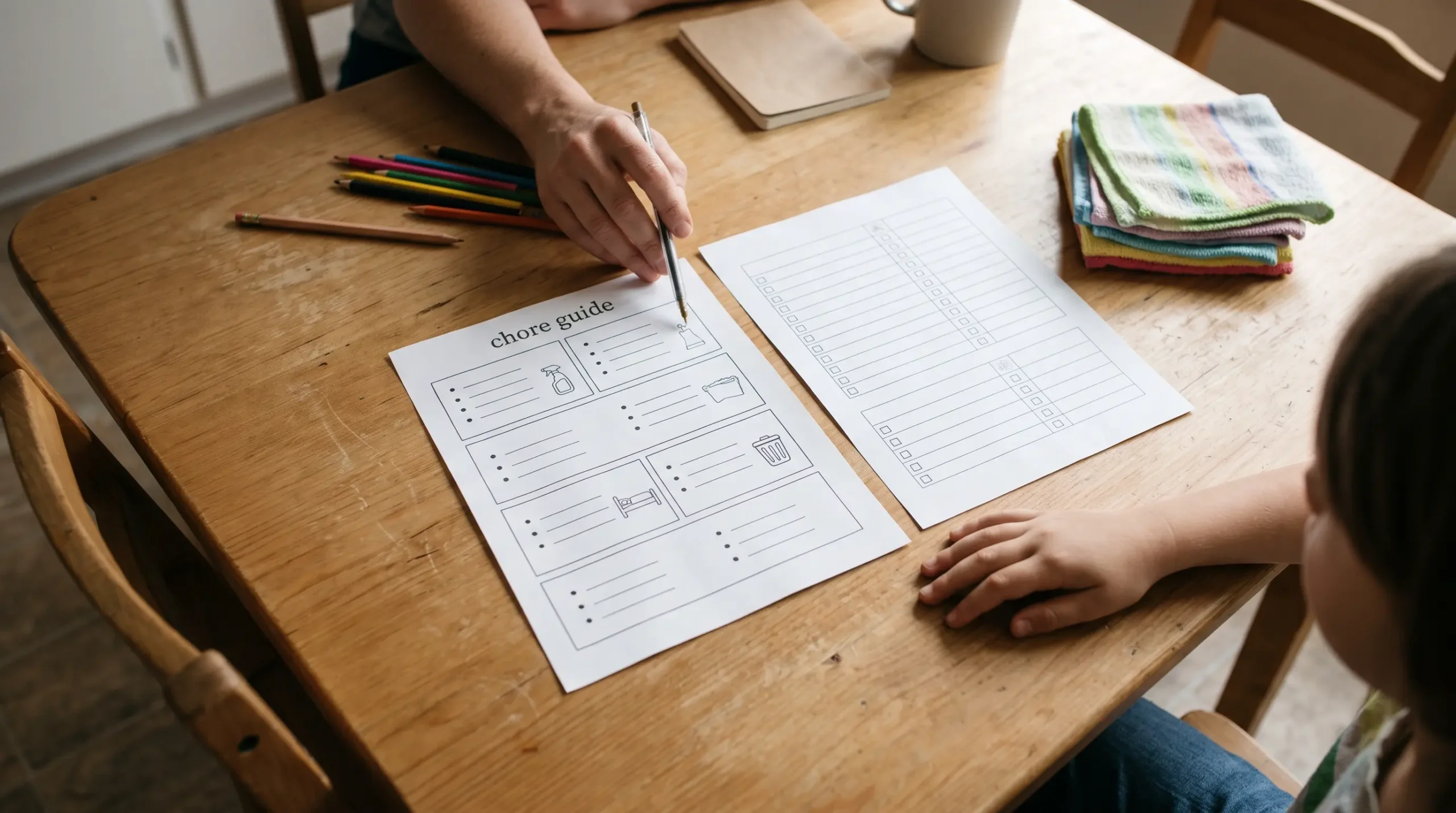
- Page 1 — Chore ideas by age: Fifteen starter ideas grouped into ages 2–3, 4–5, 6–8, 9–12, and 13–17. Use it to find possibilities, not to decide what a child must already be able to do.
- Page 2 — Ready-to-use weekly chart: Four familiar job rows, Monday-to-Sunday checkboxes, and space to note what help an adult will provide. This works if the suggested jobs match your child.
- Page 3 — Blank weekly chart: Five empty rows for your own tasks or picture cues. Pick this if your child needs a shorter sequence, different chores, or a more private, personalized list.
If you only need one new responsibility, print page 2 or 3 and fill in a single row. An unfinished-looking chart is better than one loaded with jobs nobody has time to do.
Choose a Chore With a Simple Three-Part Check
Before choosing from page 1, ask three specific questions:
- Is it safe? Can your child take part with the supervision and equipment available? Adults should handle hazardous products and tasks beyond the child’s abilities.
- Can you show what “done” means? “Help clean” is vague. “Put these three large toys into this basket” is something a young child can see and practice.
- Does it fit this week’s life? A job that takes two minutes after play may work better than a longer task squeezed between homework and bedtime.
For example, a five-year-old may be comfortable matching four pairs of socks but not sorting and folding an entire load of laundry. Write down the smaller task. That isn’t lowering the standard; it’s choosing a useful starting point.
For more possibilities beyond the 15 included in the PDF, see 30 Easy Chores Kids Can Do by Age. Keep this printable focused on the few jobs your child will actually practice.
Set Up the Chart in Five Minutes
- Pick your page. Use the ready-made chart if its rows fit. Otherwise, write your own jobs on page 3.
- Add the child’s name and week. Choose a starting day, but don’t worry about making the first week perfect.
- Circle the days the job is planned. A chore does not have to happen daily. You can leave the other day boxes unused.
- Explain one task and demonstrate it. Show the materials, where they go, and what counts as finished. Practice together before expecting independent completion.
- Decide how to mark it. A checkmark can mean the planned task was completed with whatever age-appropriate help was agreed upon. It does not have to mean the child did everything alone.
Put the chart where it can be used, not just displayed. A low noticeboard or a securely attached sheet near the usual routine may work. Older children may prefer keeping their chart in a folder instead of on the refrigerator.
Example: What a Real First Week Could Look Like
Imagine a six-year-old who has never used a chore chart. Rather than assigning four daily jobs, a caregiver chooses just two rows from the ready-to-use page:
- Put away toys or belongings: Planned for Tuesday, Thursday, and Saturday, after playtime. The job means placing the large toys from the rug into their basket.
- Help set safe table items: Planned for Monday, Wednesday, and Friday, before dinner. The child puts out placemats and napkins while an adult handles glassware and anything hot or sharp.
On Monday, the child puts out the napkins with a reminder and marks that box. The toy row stays blank because toy cleanup wasn’t planned for Monday. On Tuesday, they start putting toys away but need an adult to join them. If they finish the agreed job together, that can count as completed.
Here is the distinction that prevents unnecessary arguments: A blank box on an unplanned day does not mean a missed chore. And a job completed with planned assistance can still count. Explain those rules before the first checkmark.
If the child is overwhelmed on Thursday, the caregiver might reduce the toy job to a few items or help finish it. At the end of the week, the family can decide whether to keep the same plan, change the timing, or use the blank chart for a simpler version.
Make “Done” Clear Without Demanding Perfection
Children often hear “tidy your things” differently from adults. Before adding a task to the chart, give it a visible finish line.
- Instead of: “Clean your room.” Try: “Put the picture books on the low shelf.”
- Instead of: “Help with dinner.” Try: “Place four napkins on the table.”
- Instead of: “Do the laundry.” Try: “Fold your clean T-shirts and put them in your drawer.”
The more specific version makes it easier to teach the task and easier for a child to recognize that it’s finished. An adult may still need to help, and that’s part of learning—not a reason to withhold a checkmark.
The American Academy of Pediatrics recommends clear expectations, introducing responsibilities gradually, and recognizing children’s efforts rather than expecting flawless results.
Adapt the Printable for Your Child
For preschoolers: Use one or two tasks and add a familiar drawing beside each row. An adult can read the chart and mark completed steps. Children this young still need supervision and hands-on help.
For children with communication, sensory, mobility, or learning needs: Use fewer rows, larger picture cues, accessible tools, and help tailored to the child. For example, sorting two lightweight items while seated may be a better fit than carrying a full basket. Age ranges are suggestions, not a measure of worth or independence.
For tweens and teens: Choose practical jobs with a clear finish, and involve them in deciding when to complete them. A private checklist may work better than a public display. Leave room for schoolwork, health needs, and rest.
For more than one child: Give each child their own chart or clearly named rows. Don’t compare checkbox totals; an older child’s task may require a different amount of time or effort. If the family disagrees about how the work is divided, How to Divide Household Chores Fairly as a Family addresses that wider decision.
If you want help selecting tasks before writing the chart, you can also use the Free Kids Chore Planner by Age.
When the Chart Isn’t Working, Change One Thing
A chart won’t automatically make a difficult task easier. Look at what happened before adding consequences or more rewards.
- The child rarely starts: Move the task next to a familiar cue: “After we finish the snack, the cup goes to the counter.”
- The child starts but doesn’t finish: Shorten the job or practice one step together. The task may be larger than it looked on paper.
- There are lots of empty boxes: Check which days were actually planned. If a scheduled task was missed, ask whether timing, instructions, or support need adjusting.
- The chart causes arguments: Stop counting marks for a few days. Use the page as a visual reminder while you rebuild a manageable routine.
If you are spending the entire day prompting the same job, the chart may not be addressing the real obstacle. Our guide to getting kids to do chores without constant reminders covers that separate challenge. For organizing the larger household schedule, see How to Create a Simple Family Cleaning Routine.
Safety Boundaries for Any Chore Chart
A chart does not make an unsafe task appropriate. Adults should select jobs and supervise according to each child’s skills and circumstances.
- Keep cleaning chemicals, concentrated detergent packets, medicines, and other hazardous products secured away from children.
- Don’t assign young children jobs involving sharp knives, hot cookware, heavy items, or unfamiliar powered equipment.
- Avoid loose small magnets or tiny detachable chart accessories around children who might swallow them.
- Do not use a chore chart to make an older sibling responsible for childcare that requires a capable adult.
Health Canada warns that laundry detergent packets can cause serious harm if swallowed or if their contents reach the eyes. Keep these products out of sight and reach; don’t make handling them a child’s assigned chore.
At the End of the Week, Ask Two Questions
The PDF includes space to reflect on what felt easier and what to change next week. Use it for a short conversation, not a performance review:
- Which part could my child do with the support available? Keep that part or let them take a little more ownership if they’re ready.
- Which part was confusing, unsafe, or too much? Change the task, timing, or help before printing the next chart.
Choose one adjustment, print a fresh chart if you need one, and try again. A useful chore chart isn’t the one with the most completed boxes. It’s the one that gives your child a clear, safe way to contribute—and gives your family a plan you can actually live with.