
How to Get Kids to Do Chores Without Constant Reminders
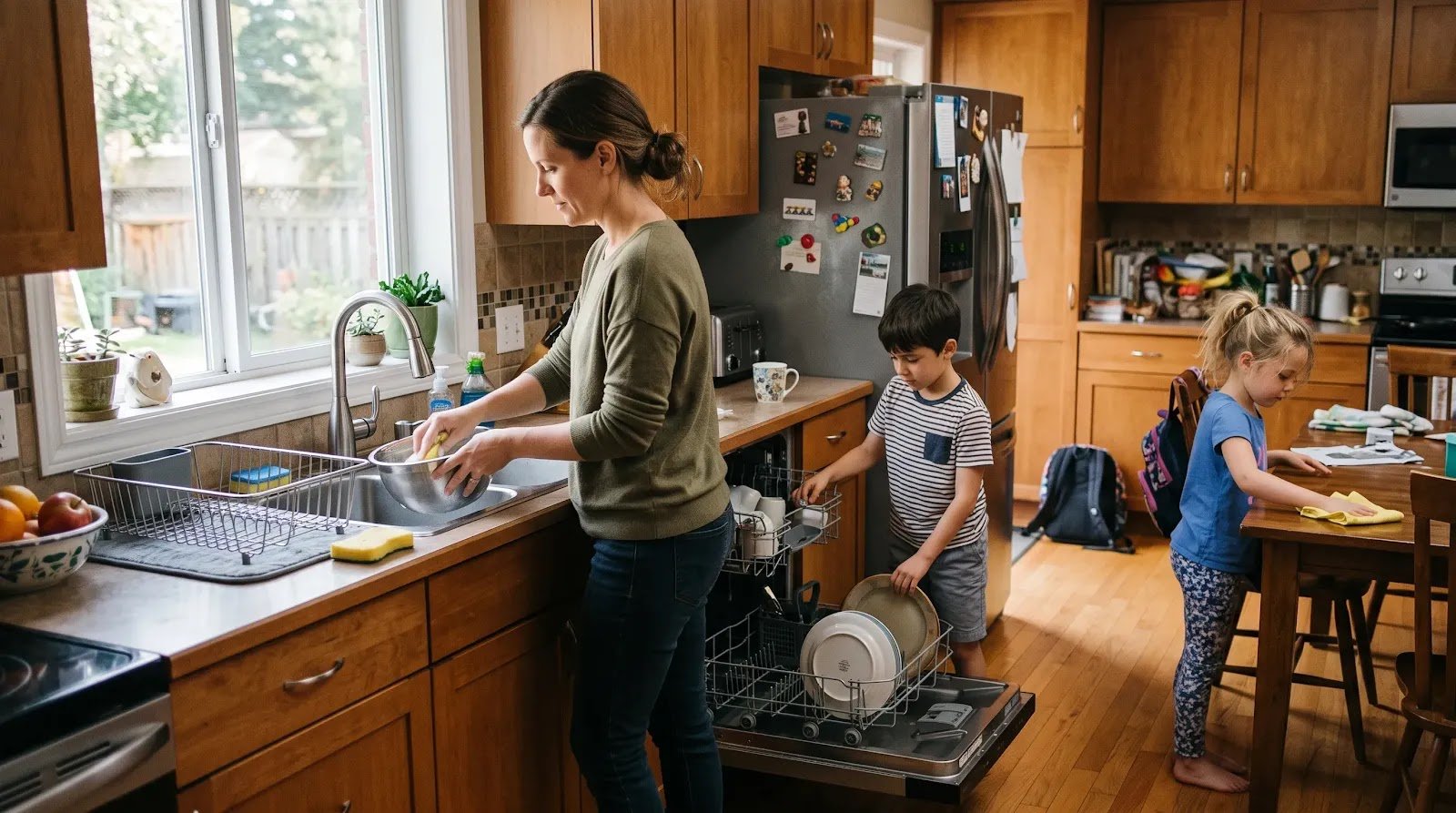
You ask your child to put away the laundry.
Ten minutes later, it is still there.
You remind them.
Then remind them again.
Eventually one small chore requires two people: the child doing the job and the parent remembering, prompting, checking, and following up.
The goal is not a child who never forgets anything.
It is a chore system that relies less on your voice and more on four things:
Clear Job → Predictable Cue → Visible Reminder → Predictable Follow-Through.
Start With One or Two Jobs, Not a Household Overhaul
If your child currently owns no regular chores, assigning ten at once does not create independence.
It creates ten new things to remember.
Start with one or two recurring responsibilities that genuinely help the household.
For example:
- Put dirty clothes in the hamper.
- Clear your plate and cup after dinner.
- Feed the pet after breakfast.
- Put away your folded towels.
HealthyChildren.org’s AAP guidance on chores and responsibility recommends age-appropriate responsibilities and introducing new tasks gradually, especially when children are not yet used to regular household jobs.
If you are deciding which chores fit your child’s age and current skills, the Free Kids Chore Planner by Age can give you a practical starting point.
Age is only a guide. Ability, safety, and supervision still matter.
1. Clear Job: Make “Done” Obvious
“Help clean the kitchen” sounds clear to an adult.
To a child, it leaves several unanswered questions.
What should I do?
How much?
When am I finished?
Compare:
“Help with the kitchen.”
with:
“After dinner, put your plate and cup by the dishwasher and wipe your place at the table.”
Or:
“Clean your room.”
with:
“Put dirty clothes in the hamper and books back on the shelf.”
A child can become independent only after the job itself is clear enough to complete.
2. Predictable Cue: Give the Chore a Home in the Day
“Remember to feed the dog sometime today” creates two jobs:
Feed the dog.
Remember when to feed the dog.
Attach recurring chores to events that already happen:
- After breakfast: feed the pet.
- After coming home: backpack and shoes go to their usual places.
- After dinner: clear the table.
- Before the bedtime routine: dirty clothes go in the hamper.
The CDC’s current guidance on routines and structure emphasizes consistency, predictability, and follow-through so children know what to expect.
The chore does not need an exact clock time.
It needs a reliable cue.
If household responsibilities need to fit around homework, meals, bedtime, and other routines, the Free Family Routine Builder can help place them into a repeatable sequence.
3. Visible Reminder: Move Some Remembering Out of Your Voice
A simple checklist or family board can carry part of the reminder load.
For a younger child, that might mean a few pictures.
For a confident reader:
- Feed dog.
- Clear plate.
- Clothes in hamper.
That is enough.
A chore system does not need to become a color-coded household dashboard that nobody checks after Tuesday.
Then change what you say.
Instead of repeating the entire instruction:
“Remember, you need to put your plate away and wipe your place and then feed the dog…”
point back to the system:
“Check your chore list.”
The reminder still exists, but the parent no longer has to recreate the whole routine every time.
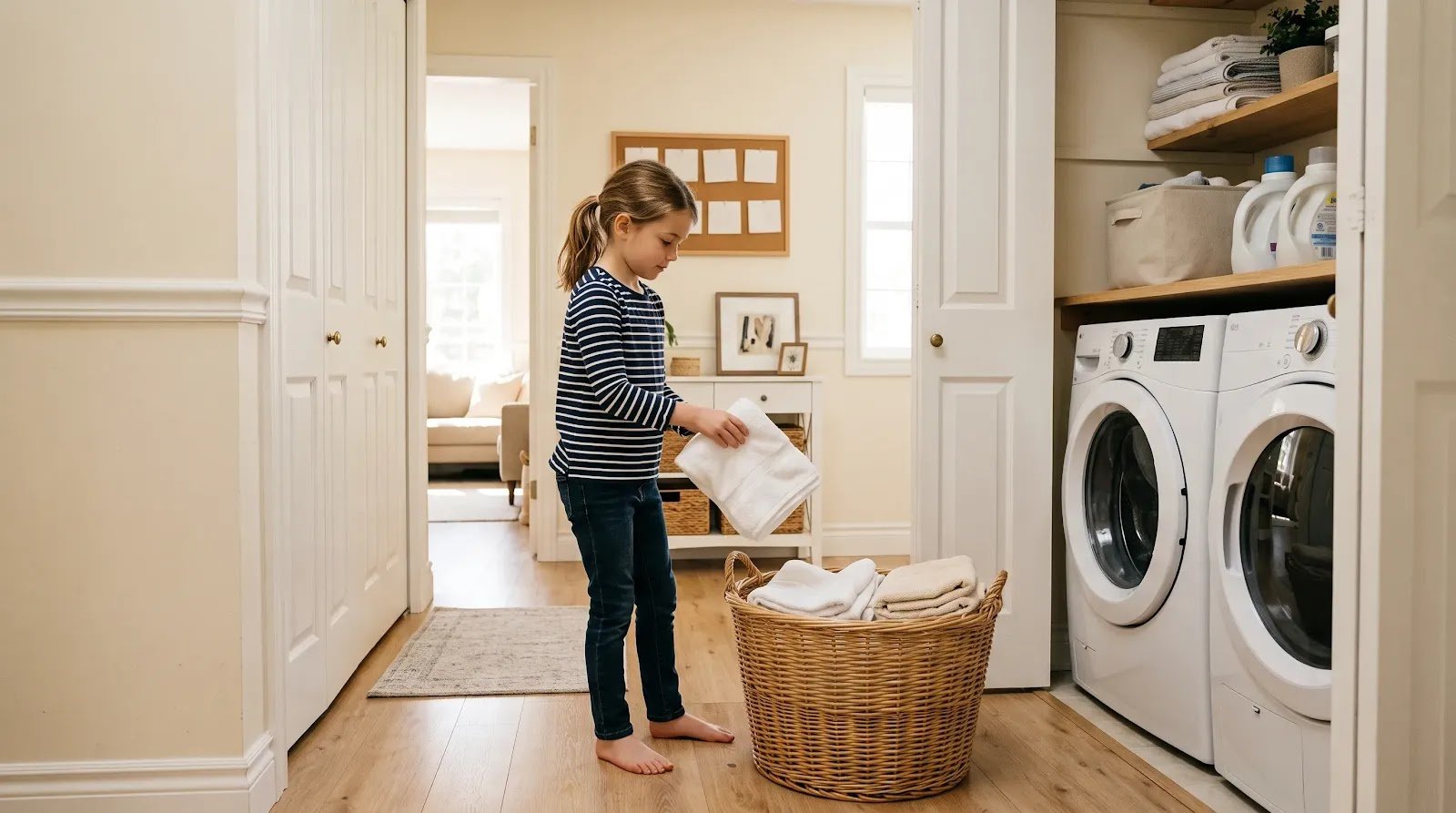
Teach the Chore Before Expecting Independence
Sometimes repeated reminders are not the real problem.
The child does not yet know how to complete the job independently.
For a new responsibility:
- Show it.
- Do it together.
- Let the child try while you stay available.
- Step back gradually once they can do it safely.
AAP guidance stresses that chores are a learning process and that parents should not expect perfection while children develop the skill.
A towel folded differently from yours can still be a folded towel.
If you redo every imperfect job in front of your child, the message can quietly become:
“Your contribution doesn’t really count unless I do it my way.”
Correct what genuinely matters—especially safety or whether the job is actually complete—and allow harmless differences.
4. Predictable Follow-Through: Decide What Happens Before You Start Reminding
If a chore becomes real only after the fifth reminder and an irritated voice, children quickly learn something:
The first four reminders do not matter much.
Decide on a simple pattern ahead of time.
For example:
“Your dishes are your job after dinner. The list is on the fridge. I’ll remind you once if you forget, and they need to be done before game time.”
This is not about making punishments harsher.
It is about making the sequence predictable.
If an optional leisure activity comes after the responsibility in your family’s routine, keep that order consistent instead of negotiating it differently every evening.
Do not use basic needs such as food, sleep, affection, school participation, or needed care as leverage for chores.
Notice When Your Child Remembers Without You
Independence can be easy to miss.
You notice immediately when the trash was forgotten.
You may not notice the afternoon your child handled it without being asked.
When that happens, be specific:
“You saw the list and took care of the trash without me reminding you.”
Or:
“You remembered your dishes after dinner on your own.”
AAP guidance recommends encouragement and specific praise as children learn responsibility.
You do not need to celebrate every plate forever.
But when independence is the skill you are building, notice it while it is growing.
If You’re Still Reminding Constantly, Debug the System
Before deciding your child simply “won’t help,” find where the system is breaking.
The Job Is Too Vague
Replace:
“Clean your room.”
with:
“Clothes in the hamper and books on the shelf.”
There Are Too Many Jobs
If the new chore system contains ten daily responsibilities, reduce it.
Build reliability with one or two jobs before expanding.
The Timing Keeps Moving
A task that happens after dinner on Monday, before homework on Tuesday, and “whenever you remember” on Wednesday is difficult to automate.
Give recurring chores recurring cues.
The Child Does Not Yet Know How
Return to teaching.
Break the chore into smaller actions and supervise until the skill is stronger.
The Reminder Is in the Wrong Place
Put the cue where the job happens.
A laundry reminder hidden in a bedroom drawer will not help much when the clothes come off in the bathroom.
The Chore Always Collides With a Difficult Part of the Day
If the task consistently lands during a rushed morning, immediately after a long school day, or in the middle of homework pressure, experiment with the timing before concluding that the child is simply resistant.
The responsibility can remain while the cue changes.
Do Not Confuse “Fewer Reminders” With “No Support”
Children forget.
Adults forget too.
The goal is not to stand silently while every chore succeeds or fails.
A younger child may need more prompting.
A brand-new chore needs more teaching.
A busy week may require extra support.
The useful question is:
“Is my child gradually relying more on the system and less on me remembering the job for them?”
When Repeating Yourself Is the Bigger Pattern
If chores are only one example and you also repeat directions about shoes, homework, getting ready, screens, and bedtime all day, the problem is broader than household responsibilities.
How to Stop Repeating Yourself to Your Kids All Day focuses specifically on that parent-child instruction loop.
Try a One-Week Chore Reset
If your current system has become reminder after reminder, simplify it for one week.
- Choose: Give each child one or two recurring jobs.
- Clarify: Define exactly what “done” means.
- Teach: Practice any job they cannot yet do independently.
- Anchor: Attach each chore to a predictable event.
- Show: Put one simple visual reminder where it will be seen.
- Follow through: Use the amount of prompting you decided on instead of escalating through repeated reminders.
- Adjust: At the end of the week, fix the weakest part of the system instead of rebuilding everything.
Do not judge the week by whether anybody forgot once.
Ask whether responsibilities became a little clearer and whether your voice carried a little less of the remembering.
The Goal Is Participation, Not a Reminder-Free House
A workable chore routine does not mean every child automatically notices every job forever.
It means responsibilities no longer exist only in the parent’s head.
Make the job clear.
Give it a predictable cue.
Put the reminder somewhere visible.
Teach the skill.
Follow through predictably.
Over time, you want to move from:
“I have to remember your chore for you.”
toward:
“You know what your job is, when it happens, and where to look if you forget.”
Fewer reminders usually begin with a system that has fewer things for the parent to keep reminding everyone about.